Furniture Manufacturers in Mexico: Top Factories List and Sourcing Guide
Mexico's furniture strength sits in four places: metal-frame furniture, hospitality and contract work, upholstered seating, and solid wood case goods, concentrated in Jalisco, Nuevo Leon, and Baja California. Finding the factories is the hard part, because supplier lists for Mexico are unusually unreliable.
Search for Mexican furniture manufacturers and you will mostly turn up domestic retail chains, a plastic resin supplier, and at least one company that makes wood-scrap machinery. The eight companies below are different: each has a documented trail in public U.S. ocean-shipment records, and together they cover several distinct Mexican furniture categories. Treat them as documented examples rather than as the whole market, because Mexican factories that ship north by truck sit outside the vessel-manifest data these lists are built from.
Weighing Mexico against Asian production more broadly? Start with the guide to manufacturing in Mexico, which covers every category, not just furniture.
What this guide covers
- Mexican furniture manufacturers with export records
- Why most manufacturer lists get it wrong
- What Mexico manufactures well
- Where the factories are
- Mexico vs Vietnam vs China
- MOQs, lead times, and payment
- Wood, compliance, and duty
- How to vet a factory
- When Mexico is the wrong choice
- Common questions
Mexican Furniture Manufacturers with Verifiable U.S. Export Records
These eight companies appear in public U.S. vessel-manifest data, cross-checked against company details, with freight forwarders and trading companies removed. Verified here means verified in public shipment records, not audited or approved by Cosmo Sourcing. None are Cosmo Sourcing clients, and inclusion is not an endorsement of fit for your product or your volumes.
| Manufacturer | Best fit | Public export evidence |
|---|---|---|
| Marbol Industrial Mueblera | Hospitality and project furniture | Progreso to San Juan, roughly 20 containers per shipment |
| Muebles Rusticos Atlantico | Metal and rustic furniture | Veracruz to Houston, 9 shipments across 21 TEU, HS 940320 |
| Creaciones Fevana | Wooden furniture, repeat programs | Veracruz to Houston, 16 shipments across 36 TEU |
| Woodgenix | Wooden furniture, large drops | Progreso to Newark, 3 shipments across 32 TEU |
| Fagor Profesional Mexico | Commercial kitchen and stainless | Progreso to San Juan |
| Malasa Mex Contract | Contract and casino furniture | Veracruz to Houston and San Juan |
| Paris Mexico Design | Retail fixtures and exhibition | Veracruz to Miami and San Juan |
| As Maquila Mexico | Bath and sanitaryware-adjacent | Tuxpan to Port Manatee, highest shipment count in the set |
Drawn from public U.S. vessel-manifest data. Shipment volume reflects ocean movements only and is not a measure of total factory output.
1. Marbol Industrial Mueblera
Hospitality furniture at project scale. The shipment records show roughly 20 containers moving per shipment, a pattern consistent with full hotel fit-outs rather than SKU-level production. A sensible call for a property package or a contract job, a poor fit for a 300-unit retail program.
2. Muebles Rusticos Atlantico
Metal furniture filed under HS 940320, with a related exporter, Rusticos San Bernardo, running a similar profile on the same route. Nine shipments across 21 TEU, a container or two at a time, which fits a mid-size program rather than a single large drop. Rustic and metal-frame is a category where Mexico competes strongly rather than merely participates.
3. Creaciones Fevana
Wooden furniture across mixed models, shipping roughly two containers at a time from Veracruz to Houston on a steady run. That pattern fits recurring programs rather than one-off projects, which usually points to a factory comfortable with repeat purchase orders and forecastable volume.
4. Woodgenix
Wooden furniture moving from Progreso to Newark. Few shipments, but roughly 11 containers in each, so low frequency here does not indicate small capacity. Worth a look if your program runs in large infrequent drops rather than monthly replenishment.
5. Fagor Profesional Mexico
Stainless steel furniture and commercial foodservice equipment. This sits in the overlap between metal fabrication and hospitality that Mexico handles well, and it is a logical starting point if your product is back-of-house rather than front-of-house.
6. Malasa Mex Contract
Casino and contract furniture. Small in shipment count but explicitly contract-oriented, which is the project-driven end of the market: specified packages, fixed install dates, and drawings rather than catalogue SKUs.
7. Paris Mexico Design
Exhibition and display furniture with assembly accessories. Retail fixtures are an underrated Mexican strength, particularly for brands rolling out store formats across North America, where a rollout schedule moves and a multi-week ocean transit cannot absorb the change.
8. As Maquila Mexico
Included as a caution as much as a lead. This company records the highest shipment count in the set, but the cargo descriptions point to bathroom furniture and chinaware sanitaryware rather than seating or case goods. It shows up in furniture searches because bathroom furniture sits inside the same HS 9403 family, which is exactly why shipment records need interpretation instead of sorting by volume. Relevant if your program is vanities or bath, not a general furniture manufacturer.
Why Most Mexican Furniture Manufacturer Lists Get It Wrong
Run the search and you will find lists naming Coppel, Famsa, and Sears Mexico. Those are domestic retail chains selling to Mexican consumers on installment credit. They will not manufacture your product.
Other lists are worse. One page ranking well today presents its "top Mexico furniture manufacturers" and includes a seller of steel drawer boxes and gas pistons, a supplier of UV-resistant polypropylene resin, and a maker of sawdust pallet block machinery. That last one builds the machines that process wood scrap, and the page says so in its own copy while listing it anyway. A widely shared "Top 20 Furniture Brands in Mexico" list opens with a Brazilian retailer and includes several more Brazilian companies further down.
What Furniture Mexico Manufactures Well (and What It Does Not)
If you are still choosing between countries rather than between factories, the comparison across furniture manufacturing countries is the better starting point. If Mexico is already on your shortlist, this is where its capability sits.
Metal-frame and mixed-material furniture
Mexico's metal fabrication base is deep, built over decades serving the automotive and appliance industries, and it transfers directly to furniture. Tubular steel frames, powder coating, and mixed metal-and-wood construction are handled well. Cosmo Sourcing's Mexico team has run metal furniture projects out of Nuevo Leon, and in our experience fabrication quality is rarely the constraint.
Hospitality and contract furniture
Hospitality and contract furniture make one of the strongest cases for Mexico versus Asia on North American projects. Hotel, restaurant, casino, and commercial fit-outs are deadline-driven and revision-prone, and a factory two days' drive from the site can absorb a mid-project change order in a way a factory several weeks away by ocean cannot.
Upholstered seating
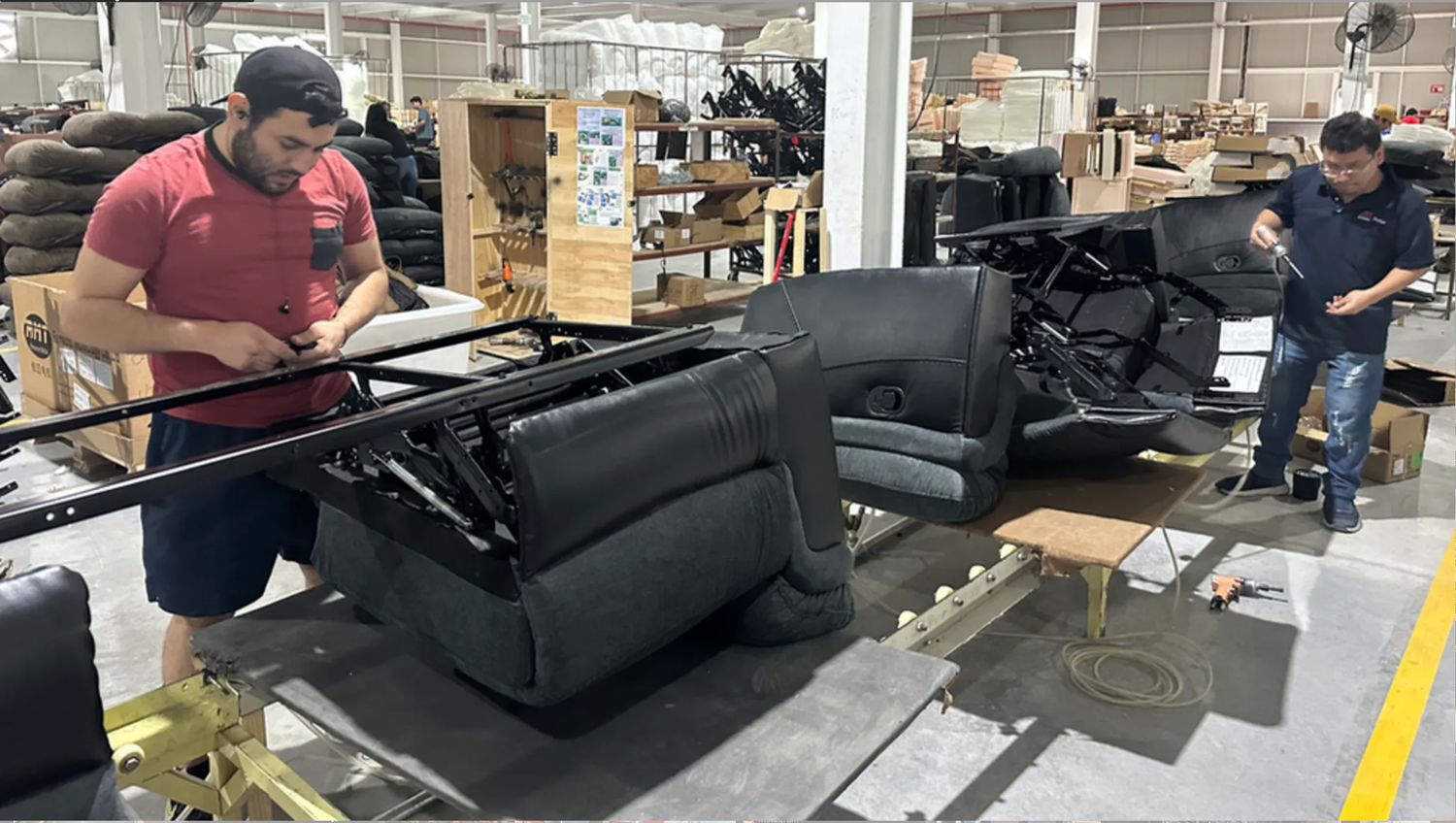
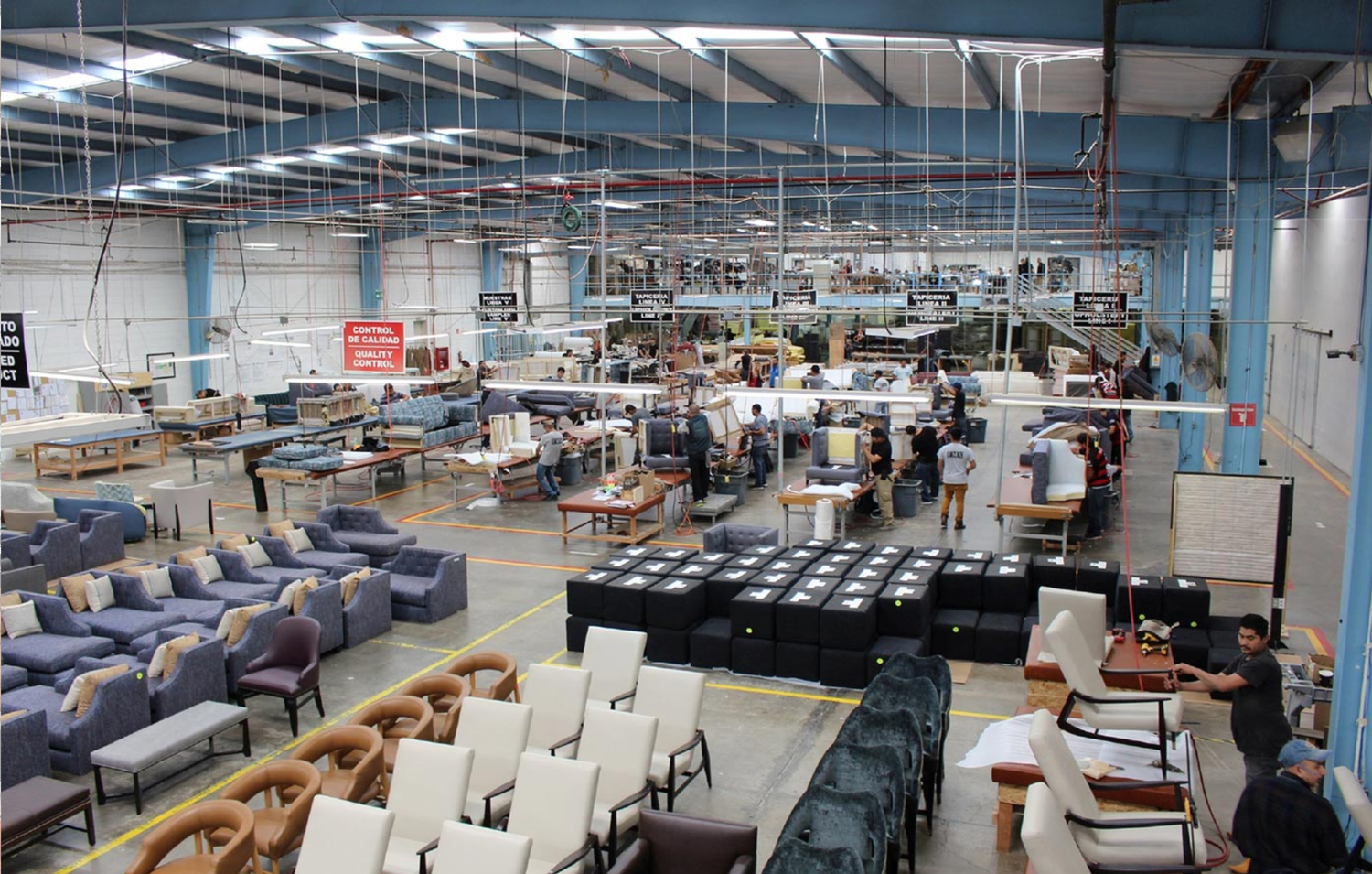
Upholstery resists automation, so it stays sensitive to both labor cost and labor skill. Among the Mexican export factories we work with, upholstery skill is generally strong, and sofas and sectionals are bulky enough that ocean freight from Asia eats much of the unit-cost advantage.
Solid wood case goods
Pine dominates, along with parota, mesquite, and cedar. Mesquite in particular is prized for hardness and a reddish grain, and resists warping better than the softwoods sitting beside it in the same catalogues. Rustic and traditional styling is the established strength; contemporary case goods are a thinner field.
Where Mexico's Furniture Factories Are
Mexican manufacturing is regional to a degree that surprises first-time buyers, and a furniture inquiry sent to the wrong cluster gets either declined or badly quoted. The full picture is in the guide to where to manufacture in Mexico. For furniture, three clusters matter.
Jalisco and Guadalajara carry the deepest woodworking tradition in the country, along with an annual furniture expo. This is the artisanal and solid-wood end of the market, and a sensible first stop for case goods and traditional styling.
Nuevo Leon and Monterrey form the industrial cluster: heavy on metal fabrication, vertically integrated, and well served by cross-border logistics infrastructure. Metal-frame and contract capability concentrates here, and it is where Cosmo Sourcing's Mexico team is based.
Baja California and the northern border host large-scale export operations serving the U.S. West Coast. Factories located close to a crossing can move goods across the border the same day, though that depends on the plant's location, carrier, and customs processing rather than on the region alone. This is also where the shelter and maquiladora model dominates, which matters if you are considering building your own operation rather than buying from an existing factory.
Mexico vs Vietnam vs China for Furniture Manufacturing
| Mexico | Vietnam | China | |
|---|---|---|---|
| Factory-gate price | Typically highest | Competitive | Often lowest at scale |
| Transit to the U.S. | 1 to 5 days by truck | 14 to 30 days by sea | 14 to 21 days by sea |
| Typical factory scale | Workshop to mid-scale | Mid to very large | Large to very large |
| Strongest categories | Metal frame, hospitality, upholstery, display | Wood case goods, outdoor, rattan, cabinets | Broadest range, deepest component base |
| Duty treatment into the U.S. | USMCA preferential treatment for qualifying goods; qualifying USMCA entries are exempt from the current Section 301 duty on Mexico | Standard rates plus current trade measures | Standard rates plus current trade measures |
| Change orders mid-production | Easiest, site visits are same-week | Difficult, requires travel | Difficult, requires travel |
| Component ecosystem | Thinner, some inputs imported | Deep and improving | Deepest |
The pattern holds across categories: Mexico rarely wins on the quoted unit price and often wins on landed cost, working capital, and schedule risk. Unlike Asian production, where the unit price tends to carry the decision, Mexican production has to be judged on total landed cost or the comparison is meaningless.
Furniture is low-density freight and usually fills a container by volume long before it reaches the equipment's weight limit. That means buyers are often paying to move cubic space rather than weight, which makes shortening the freight lane unusually valuable. This is the core of the nearshoring argument, and furniture is where it is strongest.
The higher factory-gate price is worth understanding rather than arguing with. Labor is one reason Mexican pricing can run above Asian alternatives, particularly in labor-intensive categories such as upholstery and finishing. Mexico's statutory wage floor is adjusted periodically, while actual factory wages vary by region, skill level, and local labor market conditions.
Furniture MOQs, Lead Times, and Payment Terms in Mexico
For cross-border programs, ask how the MOQ maps to a 53-foot trailer, not just to an ocean container. A 53-foot dry van carries roughly 3,800 to 4,000 cubic feet of usable space against the 2,694 cubic feet in a 40-foot high cube. Mexican factories quoting export programs often think in trailer loads, and a minimum discussed in the wrong unit produces a number neither side means.
Minimums may also be quoted by SKU, by finish, by material buy, by production setup, or by project quantity, so ask which basis the number uses before you negotiate it. In our experience Mexican factories accept smaller minimums than comparable Chinese factories, and small-batch runs are workable in furniture, particularly on custom commercial work.
Three factors drive the minimum you are quoted more than anything else. Finish count comes first: every additional stain, powder coat color, or fabric is a separate setup, and buyers routinely cut a quoted minimum by consolidating finishes rather than by negotiating. Frame commonality comes second: a collection sharing frames across SKUs means one setup with varied finishing, which prices very differently from five unrelated frames. Third is whether the factory already runs your category, because a metal furniture factory quoting an upholstered piece is quoting a new process and the minimum reflects that risk.
On payment, we commonly see new relationships start at a 30 percent deposit with the balance due on pre-shipment approval or at shipment, and established relationships move to net 30 or net 60 terms, which is a meaningful working-capital advantage over Asian sourcing that first-time buyers rarely ask about. Most export-oriented factories we deal with quote in U.S. dollars. If you receive a quote in pesos, ask for the dollar equivalent locked to a stated exchange rate for a stated window, because currency movement can erase a margin that looked fine at quotation. Settle the deposit structure before the first sample rather than after, and get sampling costs quoted separately from tooling.
Wood, Compliance, and USMCA Duty Treatment
Moisture content is the failure most buyers do not anticipate
The right target depends on the product's expected service environment: indoor relative humidity, whether the space is conditioned, and the destination climate. A typical target for conditioned North American interiors is 6 to 8 percent, and drier or more humid service environments shift that number. Furniture built wet and shipped into a dry, heated space can check, split, and open at the joints weeks after delivery rather than at inspection.
Formaldehyde compliance on composite wood
Composite wood products imported into the United States must comply with EPA's TSCA Title VI formaldehyde requirements. That includes hardwood plywood, MDF, particleboard, and finished goods containing those materials. Products sold into California should also be checked against applicable California requirements. A factory should be able to provide current documentation from its panel supplier rather than simply saying the board is "CARB compliant."
Lacey Act declarations
Many furniture products containing plant material now fall within the Lacey Act declaration schedule. Phase VII, which began on December 1, 2024, extended the requirement to a wide range of furniture and plant-product categories that had never needed a declaration before. Whether your product is covered depends on its actual HTS classification, so check the classification rather than assuming every HS 94 item is in scope. Where a declaration is required, the importer needs information including the scientific name of the plant species and the country of harvest. Declarations are filed electronically through CBP's ACE system or APHIS's Lacey Act Web Governance System; as of January 1, 2026, APHIS no longer accepts paper PPQ 505 or 505B forms. Imported hardwood supply chains deserve particular attention, since a Mexican factory using domestic pine is in a very different documentation position from one buying tropical hardwood through a broker. The Lacey Act guide covers the requirements in more detail.
USMCA origin and the 2026 tariff picture
Furniture manufactured in Mexico may enter the United States under USMCA preferential treatment when it satisfies the applicable rule of origin and the documentation requirements are met. Assembly in Mexico does not by itself make a product USMCA-originating, and the certifier has to be able to support the claim if it is questioned.
That qualification now carries more financial weight than it used to. Effective July 24, 2026, USTR imposed an additional 10 percent Section 301 duty on products of Mexico, and products entered free of duty under USMCA are specifically exempt from it. In practice, proving origin is the difference between paying that additional duty and not paying it. On the agreement itself, the first joint review took place on July 1, 2026 and the United States did not agree to renew USMCA in its current form, but the agreement remains in force while negotiations continue. The USMCA rules of origin determine whether your specific product qualifies, and rates and rules are moving, so confirm current treatment before you build a duty saving into your pricing.
How to Vet a Mexican Furniture Factory
"The pattern we see in Mexico is consistent. The fabrication is usually solid, and the gaps that cost buyers money show up in finishing consistency, packaging, and documentation, which are exactly the areas a factory tour never reveals."
Jim Kennemer, Founder of Cosmo SourcingConfirm they actually export
Ask for a customs entry or bill of lading from the last twelve months, not a brochure and not a client list. Export experience is the highest-value filter in Mexico, because the gap between a domestic-retail factory and one meeting North American retail standards is wider than the gap between a good and a mediocre factory.
Establish which lines are export and which are domestic
Many Mexican factories run both. In our experience construction specs, finishing standards, hardware quality, and packaging can differ between the two, and the samples you are shown may come from the wrong line.
Match capacity to your actual SKU mix
The eight exporters above file under similar HS codes and run operationally unrelated businesses. A factory geared to 20-container hospitality projects will not enjoy your 200-unit repeat program, and the reverse is equally true.
Inspect finishing consistency rather than sample quality
Any factory can build one good sample. What separates factories is whether unit 400 matches unit 4 on stain color, powder coat gloss, and upholstery panel matching. Ask to see a current production run, not a showroom.
Test the packaging before you trust the freight
Furniture damage is a packaging problem more often than a handling problem. Cross-border trucking involves multiple handoffs and often a trailer transfer at the border, so corner protection and edge crush ratings matter more here than on a sealed ocean container opened once.
When Mexico Is the Wrong Choice for Furniture
Rattan, wicker, bamboo, and lacquerware are Southeast Asian categories with no meaningful Mexican export base. Very high volume, single-SKU, price-driven programs also tend to favor Asia, because Mexican furniture production skews toward workshop and mid-scale operations rather than the single-campus factories common in China and Vietnam. If your program needs one factory running a hundred containers a year of one item, run the numbers against Vietnam furniture manufacturers first.
Mexico is also the wrong answer if your only reason for looking is tariff avoidance. Origin rules exist to catch exactly that, and a Mexican assembly step on largely foreign components may not qualify for USMCA treatment at all.
Common Questions About Sourcing Furniture from Mexico
How do I find furniture manufacturers in Mexico?
Mexico does not have one dominant manufacturing marketplace comparable to Alibaba in China, so the search runs through several channels, each with a different blind spot. Public ocean-shipment databases only capture sea freight, so they miss truck-only exporters entirely. Trade shows such as the Guadalajara furniture expo surface companies actively marketing for new business, which is useful but self-selecting. Chamber and industry directories, including CANACINTRA listings, can be outdated or loosely categorized. Referrals and local factory research reach suppliers that never appear in English-language search results at all, which is why on-the-ground work still matters here.
Is furniture made in Mexico good quality?
In our experience the fabrication is generally strong, particularly in metal work and upholstery. Where quality problems tend to appear is finishing consistency across a production run, packaging that has to survive multiple handoffs at the border, and documentation. The largest single quality variable we see is whether the factory builds for export or for the Mexican domestic market, since construction standards, hardware, and finishing specs often differ between the two.
Is furniture from Mexico cheaper than from China?
Usually not at the factory gate. It is often cheaper on landed cost once you add ocean freight, duty, and the inventory you carry to cover a multi-week transit. Model landed cost, not unit price, or the comparison will mislead you.
Do Mexican furniture factories work with small businesses?
More readily than Chinese factories at comparable quality, and lower minimums are common. Aim at the mid-size factories rather than the large contract houses, which are geared to project work and will usually pass on a small program. What helps most is arriving with complete drawings and a realistic repeat forecast, because a factory taking a small first order is really betting on the second one.
What is the minimum order for furniture from Mexico?
It depends more on finish count and frame commonality than on the product itself. Ask what basis the minimum uses, since it may be quoted per SKU, per finish, per material buy, or per production setup, and expect the number to move once you consolidate finishes. There is no single Mexican standard, so a first quoted minimum is an opening position more often than buyers assume.
Can Mexican factories manufacture my own furniture designs?
Yes. Mexican factories skew toward OEM production built to your drawings rather than rebranding an existing catalogue. Send full construction drawings with dimensions, materials, joinery, hardware, finish specifications, and a written moisture content target. Agree in writing who owns any tooling, jigs, or patterns before work starts, because that clause decides whether you can move production later.
Is furniture from Mexico duty free into the United States?
It can be, if it qualifies under USMCA and you can document it. Qualification turns on the rule of origin for your specific HTS code rather than on where final assembly happened. It also matters more than it used to: since July 24, 2026 a Section 301 duty of 10 percent applies to products of Mexico, and qualifying USMCA entries are carved out of it while non-qualifying goods are not. Ask the factory which origin rule applies to your product and who will sign the certification, and get that answer during quoting rather than after the first load is booked.
Can I find Mexican furniture factories on Alibaba?
Only partially. Coverage of Mexican manufacturers is much thinner than coverage of Chinese suppliers, and every listing still needs to be checked to determine whether the company is the actual factory, a distributor, or a trading intermediary. Treat it as one input rather than as a complete supplier-discovery tool for Mexico.
How long does furniture production take in Mexico?
Production time itself is broadly comparable to Asia for similar products. The scheduling risk is the calendar rather than the line. Ask the factory for its production calendar during quoting, pay attention to Semana Santa and to late December and early January closures, and confirm whether that specific plant takes a summer maintenance shutdown. Then build the closures it names into the contracted delivery schedule rather than discovering them in week six.
Sourcing Furniture from Mexico with Cosmo Sourcing
Cosmo Sourcing has had a team on the ground in Nuevo Leon since 2023, and has run metal furniture and hospitality furniture projects out of Mexico alongside a Vietnam operation running since 2014. That combination matters here, because the honest answer to "should I make this in Mexico" is sometimes no, and a sourcing company working in one country only is not positioned to tell you.
Unlike commission-based sourcing agents who take a percentage of order value, Cosmo Sourcing charges a fixed fee, with no commissions and no markups on production. A project delivers original quotes from two to six vetted factories, full contact details, and direct introductions, so the factory relationship belongs to you from the start. The Mexico sourcing company page covers how those projects run.
Send your specs, target volumes, and deadline to info@cosmosourcing.com or start on the contact page.