Manufacturing Wages in Mexico 2026: Labor Costs by Role and Region
Manufacturing wages in Mexico average about $5.00 USD per hour in 2026 per INEGI data. Total employer cost for an entry-level operator runs roughly $3.50 to $5.50 per hour depending on region. The 2026 minimum wage is 315.04 pesos per day nationally and 440.87 pesos in the northern border zone: the floor under every factory quote.
Here is the thing most wage guides get wrong: they are written for companies opening their own plant in Mexico, with headcount budgets and payroll systems. If you outsource manufacturing to a factory instead, you will never pay a Mexican factory worker directly. Your factory does. But wages are the largest single input behind the unit price on your quote, and they move every January. Cosmo Sourcing has operated an on-the-ground team in Nuevo Leon since 2023, and reviewing factory quotes is what that team does all day. This guide covers what Mexican factories actually pay in 2026 and, more importantly, what that means for anyone sourcing from Mexico rather than manufacturing there themselves.
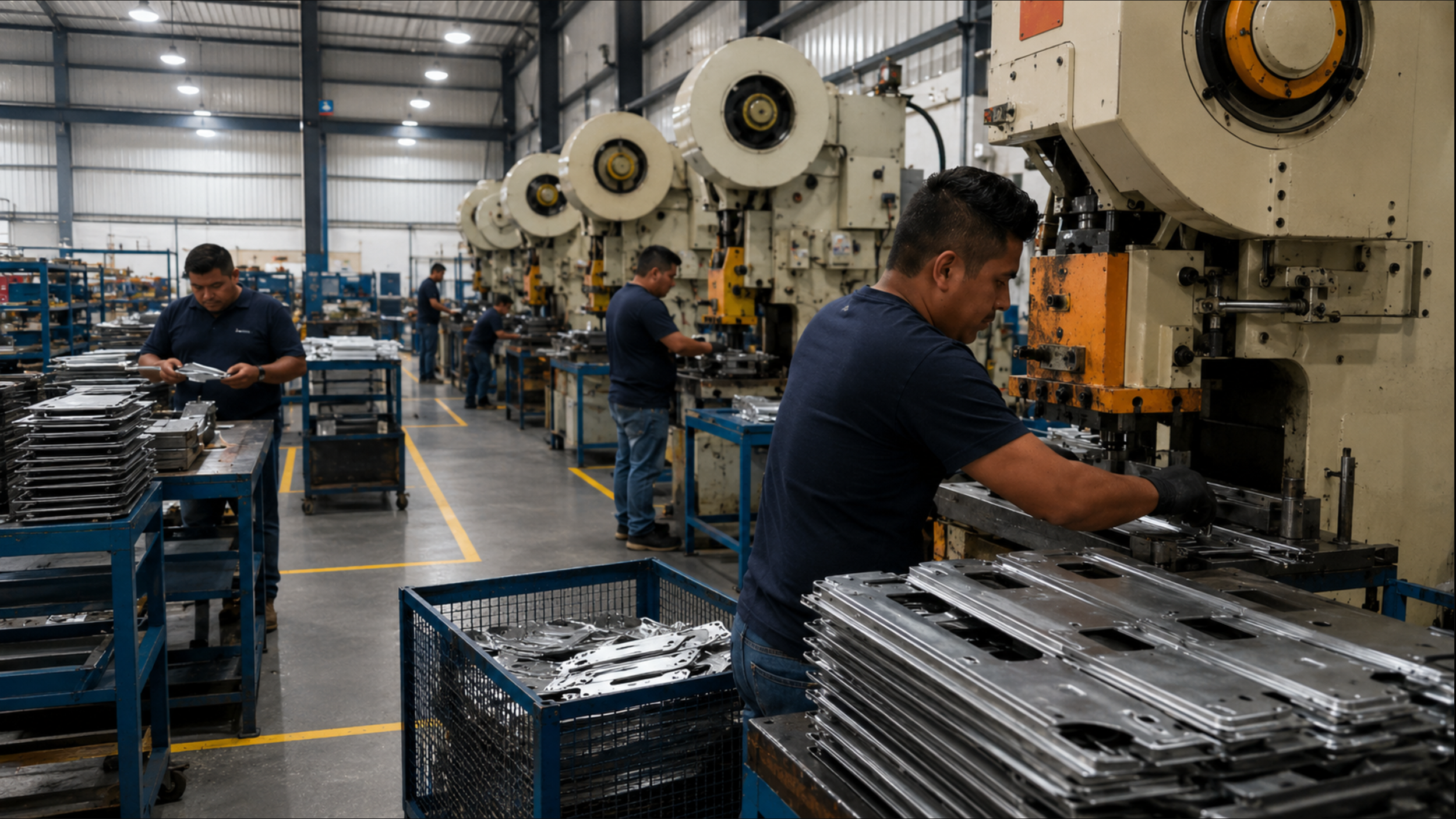
Mexico Manufacturing Wages in 2026: The Key Numbers
Mexico's minimum wage commission, CONASAMI, raised the national floor 13 percent for 2026, to 315.04 pesos per day (about $18 USD at 17.5 pesos per dollar, the market rate in mid-2026). The northern border free zone, which covers cities like Tijuana, Ciudad Juarez, and Reynosa, has its own higher floor: 440.87 pesos per day for 2026 (about $25 USD). After a cumulative increase of roughly 200 percent since 2017, the legal minimum now sits close to actual entry-level pay in much of central Mexico, which is why every January adjustment moves real factory costs, not just a statutory number.
| Role | Typical base pay (2026) | Approx. total employer cost |
|---|---|---|
| Legal minimum, national | 315.04 MXN per day (about $18/day) | Floor, not a market rate |
| Legal minimum, border zone | 440.87 MXN per day (about $25/day) | Floor, not a market rate |
| Entry-level production operator | Near the local floor in central Mexico; 15 to 25 percent above it in border cities and tight markets | ~$3.50 to $5.50 USD per hour |
| Experienced operator, 1 to 3 years | Roughly 20 to 30 percent above entry level in the same market | ~$4.50 to $6.50 USD per hour |
| Skilled technician, welder, CNC | 14,000 to 22,000 MXN per month in northern hubs | ~$5.50 to $8.50 USD per hour |
| Engineering and plant management | Salaried, varies widely | Up to ~$45 to $48 USD per hour at the top end |
Notes on the table: operator pay is quoted daily and skilled pay monthly, because that is how Mexican factories quote them; the employer-cost column is the number that reaches your unit price; and the $5.00 INEGI average blends operators with technicians and engineers, so it sits above operator-only costs by design.
For scale, Mexico's manufacturing sector employs roughly nine million people, and the brands made in Mexico range from global appliance and automotive names to the mid-size factories most buyers actually work with.
How Mexican Wages Are Actually Structured
Mexico's pay system takes a minute to decode, and getting it right matters: the gap between a factory's base wage and its true labor cost is where most bad cost math starts.
The daily rate system
Mexican labor law expresses all wages as a daily rate in pesos, the salario diario, paid for 365 days per year. There is no legal concept of an hourly wage. The standard full-time schedule is 48 hours across six days, and overtime is expensive by design: double pay for the first nine overtime hours in a week, triple pay after that. When a factory quotes you a rush order, that overtime structure is a real cost they are absorbing or passing through, not a negotiating fiction.
Mandatory benefits: IMSS, INFONAVIT, and the rest
On top of the base wage, every formal employer in Mexico pays social security (IMSS), a housing fund contribution (INFONAVIT, 5 percent of salary), and retirement contributions (SAR). Employees are also entitled to an aguinaldo, a year-end bonus of at least 15 days' pay, a minimum of 12 vacation days after the first year with a 25 percent vacation premium, and statutory profit sharing (PTU), which distributes 10 percent of a company's taxable profit to employees.
The fully burdened multiplier
Add it up and mandatory contributions plus statutory benefits typically raise labor cost 40 to 60 percent above the base wage. Run that on the 2026 national floor: a 315.04 peso daily base becomes roughly 440 to 500 pesos per day of real employer cost, which works out to about $3.10 to $3.60 per hour. Export factories in competitive hubs then pay above the floor and layer on transport, meals, and attendance bonuses, which is why payroll benchmarks from large export manufacturing operations put the true total for an entry operator near $5.50 per hour in the border zone and the major export clusters. Any comparison built on Mexican base wages alone makes Mexico look 40 to 60 percent cheaper than it is.
Manufacturing Wages by Region in Mexico
Mexico does not have one labor market. Wage levels track the industrial clusters, and the cluster you source from is usually determined by your product category.
The northern border zone
Tijuana, Mexicali, Ciudad Juarez, and Reynosa carry Mexico's highest wage floor and its tightest labor markets. Operator wages run 15 to 25 percent above central Mexico because factories compete with each other and with employers across the US border for the same workers. This is where electronics assembly, medical devices (Tijuana and Mexicali dominate that cluster), and a large share of export manufacturing concentrate. You pay more per labor hour here; you get proximity to US ports of entry and deep export experience in return.
Nuevo Leon and Monterrey
Monterrey is Mexico's industrial capital: appliances, metal fabrication, packaging, and a dense base of mid-size factories serving export supply chains. Wages sit in the upper-middle of the national range, below the border zone but above the Bajio for comparable roles. This is where Cosmo Sourcing's Mexico team is based, and it is the first stop for many product categories precisely because factory depth keeps quotes competitive despite the wage level.
The Bajio corridor
Queretaro, Guanajuato, Aguascalientes, and San Luis Potosi form the automotive and aerospace belt. General operator pay here sits closest to the national floor, in the low-to-mid 400s of pesos per day once benefits are included, while certified automotive and aerospace plants pay premiums for experienced roles. The trade-off for smaller consumer-product buyers is that automotive-grade factories often carry certifications and minimums that are overkill for their orders.
Central and southern Mexico
Puebla, Tlaxcala, and points south run the lowest wage tiers in the formal manufacturing economy. Textiles and apparel cluster here, which is one reason clothing manufacturers in Mexico can stay price-competitive on denim and uniforms even as national wages climb. Labor availability is good; export logistics take more planning than in the north.
What Mexican Wages Mean for Your Factory Quote
This is the section the payroll guides skip, and it is the only reason wage data matters to a buyer.
Labor content decides where Mexico pencils
Every product has a labor content: the share of unit cost that is wages. A sewn backpack or hand-assembled item might carry 30 to 50 percent labor content. An injection-molded or machine-formed product might carry 10 percent. Mexican operator labor typically costs one and a half to two times Vietnam's on a loaded basis, so on high-labor products, the factory-gate price from Mexico will usually lose. On machine-time products, the wage gap barely moves the unit price, and Mexico's advantages (duty-free treatment under USMCA for qualifying goods, truck freight measured in days, same-time-zone communication) take over. That is the honest version of the nearshoring math: it is a landed-cost decision, not a wage decision.
According to Jim Kennemer, founder of Cosmo Sourcing, sourcing from Asia since 2012: "Buyers get fixated on the per-hour gap between Mexico and Asia, but the quote you should care about is landed cost. On the right product, you pay more per labor hour in Mexico and still come out ahead after duties, freight, and cycle time. On the wrong product, no amount of proximity saves the math. We run that model before recommending either direction."
How the January wage increase reaches your quote
CONASAMI announces the new minimum wage each December, effective January 1. Factories reprice in the first quarter: market wages get renegotiated against the new floor, IMSS contributions recalculate, and union contracts in the industrial north adjust. Real wages inside export factories rose about 2.9 percent year over year through early 2026 per INEGI's IMMEX reports, even as some plants trimmed headcount. Practical translation: a quote you received in October is soft by February. If you are placing a repeat order, lock pricing before the December announcement or budget for a low single digit unit price increase on labor-heavy products each year. Factories operating under the IMMEX export framework feel this the same as everyone else; if you want the mechanics of that structure, here is how maquiladoras work.
Reading a wage-driven price increase
Some price increases are legitimate wage pass-through. Some are padding that arrives dressed as one. A factory with a real case can show you the math: the percentage of your unit cost that is labor, the January increase percentage, and the resulting adjustment. A 13 percent minimum wage increase on a product with 20 percent labor content justifies something in the neighborhood of a 2 to 3 percent unit price move, not 10. When Cosmo Sourcing's Nuevo Leon team reviews quotes for clients, wage pass-through is one of the first line items checked, because it is the easiest place for a factory to round up and the easiest to verify against published wage data.
Mexico vs China vs Vietnam Labor Costs
The country decision is bigger than wages, but wages are where it starts. Here is the 2026 picture, using loaded manufacturing labor costs where available.
| Country | Manufacturing labor cost (2026) | What it means for buyers |
|---|---|---|
| Mexico | ~$5.00 USD/hour average earnings; $3.50 to $5.50 loaded for entry operators | Wins on landed cost for North American markets when labor content is low to moderate |
| China | ~$6.50 USD/hour (ILO estimate) | No longer the cheap option; wins on component ecosystems, scale, and complex electronics |
| Vietnam | ~$300 to $340 USD/month base for factory workers; roughly $2 to $3/hour loaded | Wins factory-gate price on high-labor products: apparel, footwear, soft goods, furniture |
| United States | $20.95/hour median assembler base wage (BLS); $25 to $45 loaded | The benchmark Mexico is measured against for reshoring-adjacent decisions |
The detail that surprises most buyers: on average national figures, Chinese and Mexican manufacturing labor costs have converged, and by some measures China is now the more expensive of the two. China's advantage in 2026 is industrial depth, not wages. Vietnam remains the labor cost leader of the three, which is why the right answer is often a split: Vietnam for the sewn and assembled products, Mexico for the heavy, bulky, or fast-replenishment products serving North America. Cosmo Sourcing breaks that decision down product by product in the guide to Vietnam vs China vs Mexico for product sourcing. Duty treatment differs by importing country, so check current rates for your home market before running the comparison.
Where Mexican Wages Are Headed
Budgeting for a Mexico program means budgeting for wage growth. Two forces are locked in.
The minimum wage trajectory
The 200 percent increase since 2017 was policy, not accident, and the political commitment to real wage growth has carried across administrations. The 2026 increase was 13 percent nationally. Companies modeling Mexican operations typically plan for 8 to 12 percent annual wage escalation over the next few years. For buyers, that compounds into a predictable low single digit annual drift in unit prices on labor-heavy products, which is worth writing into any multi-year supply agreement.
The 40-hour workweek reform
Mexico is moving from its 48-hour standard week toward 40 hours, with the phase-in expected to begin in 2027. Same weekly pay across fewer hours raises effective hourly cost, and factories will either add headcount, add overtime, or reprice. Expect Mexican quotes from 2027 onward to carry this; a factory that flags it transparently is a good sign, not a problem.
Frequently Asked Questions
How much do factory workers earn in Mexico in 2026?
Entry-level production operators cost their employers roughly $3.50 to $5.50 USD per hour fully loaded in 2026, with base pay starting near the legal floor of 315.04 pesos per day in central Mexico and 15 to 25 percent higher in border cities. Average manufacturing earnings across all roles are about $5.00 per hour per INEGI data.
Is manufacturing labor cheaper in Mexico than in China?
The two have converged: Mexican manufacturing earnings average about $5.00 per hour in 2026 against ILO estimates of roughly $6.50 for China, so by average figures Mexico is no longer the more expensive option. China's remaining edge is supply chain depth and scale, not wages, which is a reversal of the assumption most buyers still carry.
What is the minimum wage in Mexico in 2026?
The national minimum is 315.04 pesos per day (about $18 USD), a 13 percent increase over 2025. The northern border free zone minimum is 440.87 pesos per day (about $25 USD). Market wages in industrial clusters run above both floors, though the gap has narrowed as the minimum has climbed.
Why is Vietnam still cheaper than Mexico for some products?
Vietnamese factory labor runs roughly $2 to $3 per hour fully loaded, against $3.50 to $5.50 for Mexican operators. On products where labor is 30 to 50 percent of unit cost, such as apparel, footwear, and other sewn goods, that gap usually decides the factory-gate price in Vietnam's favor even after freight and duties.
Get Real Mexico Factory Quotes from Cosmo Sourcing
Cosmo Sourcing has sourced 10,000+ products since 2012, with an on-the-ground team in Nuevo Leon since 2023. Unlike commission-based sourcing agents who take a percentage of the order value, Cosmo Sourcing works as a Mexico sourcing company on a fixed fee, with no commissions, no markups, and every quote passed to you unaltered. A typical project delivers original quotes from 2 to 6 vetted factories with contact details and direct introductions, so you can see exactly where labor cost lands in your unit price. Tell us what you are making and we will tell you honestly whether Mexico pencils: info@cosmosourcing.com or cosmosourcing.com/contact-us.