How to Outsource Manufacturing: A Step-by-Step Guide for Product Sourcing
Outsourcing manufacturing means partnering with an external factory to produce your product rather than building production capacity in-house. For most small and mid-size brands, it is the fastest and most cost-effective way to bring a physical product to market. But the process involves far more than placing a purchase order. It requires finding the right factory, validating their capabilities, managing sampling, overseeing production, and coordinating logistics across time zones and languages.
After helping thousands of clients outsource product development and manufacturing across Vietnam, Mexico, Thailand, and Indonesia, we have seen what works, what fails, and where most first-time buyers get stuck. This guide walks through the entire journey from your first factory search to managing ongoing production at scale.
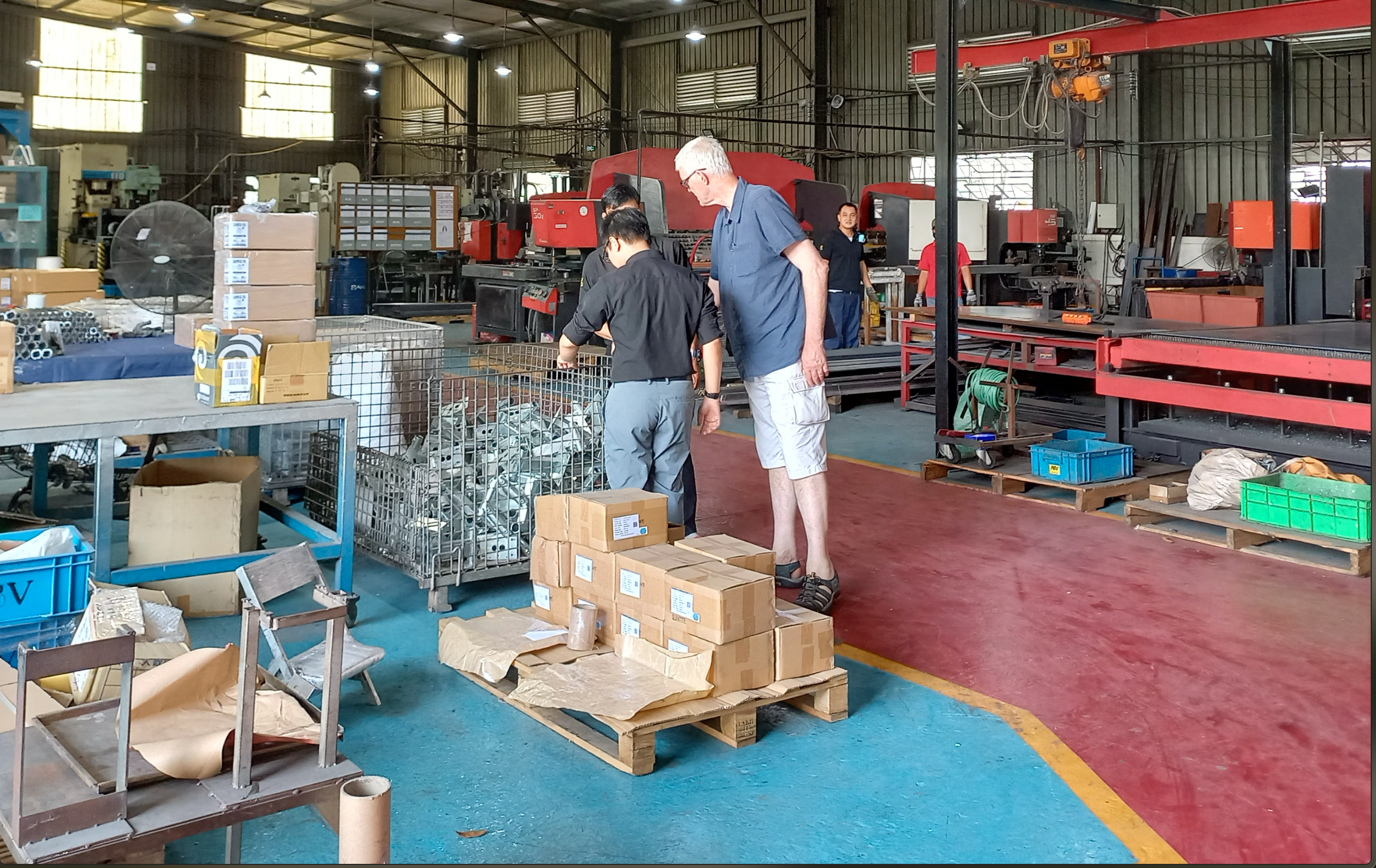
A Cosmo Sourcing client visiting a facotry in Vietnam
What Outsourced Manufacturing Actually Involves
Outsourcing your manufacturing is not a single transaction. It is a relationship you build over time with a factory (or multiple factories) that becomes an extension of your supply chain. The process typically moves through four stages:
Initial Research and Country Selection
Before you contact a single factory, you need to decide where to manufacture. That decision depends on your product category, target landed cost, order volume, and your end customers' locations.
Vietnam is one of the strongest options for garments, footwear, furniture, bags, and an expanding range of hard goods. Mexico makes sense for products sold primarily in North America, especially bulkier items where freight costs from Asia eat into margins. Thailand and Indonesia each have their own strengths in rubber, automotive components, and food-grade packaging.
We recently helped a client manufacturing canvas bags evaluate Vietnam against China. The Vietnamese factory quoted a higher unit price, but the client's total landed cost was lower once tariff differentials and shorter lead times to their Australian warehouse were factored in. Country selection is rarely about unit price alone.
Factory Identification and Vetting
This is where most first-time buyers underestimate the difficulty. Finding factories that appear online is easy. Finding the right factory for your specific product, volume, and quality requirements is a challenge entirely its own.
The best-fit factories for your product often do not have English-language websites. They do not list on Alibaba. They get their orders through relationships, trade shows, and sourcing professionals who visit their facilities in person. When we source outdoor furniture in Binh Duong Province, for example, we are visiting factories clustered within 30km of Thu Dau Mot that most buyers would never find through an internet search.
Sampling and Pre-Production
Once you have identified potential factories, the sampling process begins. This is your opportunity to validate quality, communication, and production capability before committing to a full order.
Production and Logistics
The production run itself, quality control during manufacturing, and coordinating shipment to your warehouse or fulfillment center.
Each of these stages has its own set of decisions, risks, and common mistakes. The sections below break down the practical details.
How to Find the Right Factory
Finding a factory is not the hard part. Finding the right one is. Here are the most common approaches, along with their real limitations.
Online Directories and Marketplaces
Platforms like Alibaba and Global Sources, as well as Vietnam-specific directories such as Vietnam Yellow Pages, give you access to thousands of listings. The problem is that these platforms favor factories that invest in marketing, not necessarily the ones best suited to your product. Many listings are trading companies presenting themselves as manufacturers. Verifying who actually makes the product requires deeper digging.
Trade Shows
Events like Canton Fair, VietnamExpo, and MIDEST (for Mexico and Latin America) let you meet factory representatives in person, see product samples, and compare options side by side. Trade shows are valuable but time-intensive, and they only occur a few times per year.
Sourcing Companies
A sourcing company with on-the-ground teams can significantly shorten the process. At Cosmo Sourcing, a typical project delivers 2 to 6 qualified factory options within weeks because our teams in Ho Chi Minh City and Binh Duong visit facilities, review production lines, and verify capabilities firsthand rather than relying on online profiles.
Direct Outreach
If you already know which factories you want to work with, reaching out directly can work. But expect slower response times, language barriers, and limited leverage on pricing and terms without volume history or a local presence.
Regardless of how you find candidates, every factory needs to be vetted before you place an order.
Vetting a Factory Before You Commit
Skipping proper vetting is the most expensive mistake in outsourced manufacturing. A factory that looks great on paper can deliver late, miss quality specs, or disappear after receiving your deposit.
Verify Production Capability
Request a factory tour (in person or via video). Ask to see the production lines relevant to your product, not just a showroom. Look at the equipment, the workforce, and the current orders on the floor. A furniture factory in Vietnam that claims to handle 500 tables per month should have the CNC equipment and finishing lines to back up that claim.
Check References and Export History
Ask for references from existing clients, ideally in your market. Cross-reference with customs data where available. A factory that claims to export to 30 countries should have a verifiable shipping history.
Request Certifications
Depending on your product and destination market, you may need factories with ISO 9001, BSCI, FSC (for wood products), GOTS (for organic textiles), or other certifications. Get copies upfront. Do not take verbal confirmation.
Assess Communication Quality
How quickly and clearly does the factory respond during the quoting process? This is a preview of how communication will go during production. If responses are slow or vague before they have your money, expect worse after.
Managing Your First Production Run
Your first order with a new factory is a proving ground. Keep volumes modest, stay closely involved, and build in checkpoints.
Get Sampling Right
Never skip the sample stage. Request a pre-production sample that matches your final specs exactly, including materials, dimensions, color, packaging, and labeling. For most products, expect 2 to 3 sample rounds before approval. Garment factories in Vietnam typically turn around samples in 10 to 15 days. Injection-molded plastic parts take longer, usually 30 to 45 days, because of tooling.
We had a client last year who approved a handbag sample based solely on photos, without holding the physical sample. The first production run arrived with handles that felt flimsy because the factory had substituted a thinner webbing material. Always hold the sample in your hands.
Set Clear Production Milestones
Do not wait until the container is loaded to check on progress. Establish milestones: raw material procurement, production start, mid-production check, and pre-shipment inspection. Each milestone should have a target date and a verification step.
For a standard garment order of 2,000 to 5,000 pieces, a typical timeline from sample approval to shipment looks like this: fabric sourcing (2 to 3 weeks), cutting and sewing (3 to 4 weeks), finishing and packing (1 week), pre-shipment inspection (2 to 3 days). Total: roughly 45-60 days.
Conduct Quality Inspections
At a minimum, conduct a pre-shipment inspection before the goods leave the factory. Better practice is also to run an in-line inspection during production, when 30% to 40% of units are complete. This catches systemic issues early enough to correct them.
Color matching is the most common QC failure we see with Vietnamese textile factories. If your product involves specific Pantone colors, send physical swatches and confirm them against the production fabric, not just the sample.
Understand Payment Terms
Standard terms for a first order are 30% deposit upon order confirmation, 70% balance before shipment. Some established factories will negotiate a 30/70 split, with the balance payable against the bill of lading. Never pay 100% upfront to a factory you have not worked with before.
From One-Off Orders to Ongoing Production Management
The first successful order is just the beginning. If your product sells and you need to reorder, or if you are expanding your product line, the management challenge grows quickly.
The Reorder Cycle
Reorders are simpler than first orders, but they still require attention. Factories sometimes change materials between runs, shift your order to a different production line, or adjust lead times based on their current capacity. Without someone checking in, quality and timelines can drift.
Scaling Across Multiple Factories
Many brands eventually work with more than one factory, either for different product categories or to reduce risk. Managing two or three factories across different countries multiplies the coordination challenges: different communication styles, holiday schedules, and quality norms.
When a Buying Office Makes Sense
This is the point where many growing brands realize they need a permanent presence in their manufacturing region. A buying office provides exactly that: a dedicated local team that manages your factory relationships, conducts regular quality inspections, coordinates production schedules, and handles the day-to-day communication that keeps your supply chain running.
The alternative is hiring your own staff in-country, which means setting up a legal entity, navigating local labor law, finding and managing employees remotely, and absorbing the overhead whether you have active orders or not. For most brands doing $500K to $5M in annual sourcing, a buying office offers the benefits of local presence without the fixed costs and complexity of your own office.
If you are curious about how buying offices compares to other sourcing models, our guide on what a buying office actually does breaks down the differences. And if production management specifically is your pain point, the guide on managing a factory overseas covers the operational side in detail.
Outsourcing Product Development vs. Manufacturing
Some buyers come to us not with a finished product ready for production, but with a concept that still needs development. Outsourcing product development is a related but distinct process.
What Product Development Outsourcing Includes
Product development typically covers industrial design refinement, material selection, prototyping, tooling design, and engineering for manufacturability. The goal is to get from a concept or rough prototype to a production-ready specification.
Where Development and Manufacturing Overlap
The smartest approach is to develop your product with the factory that will eventually manufacture it. This avoids the common problem of designing a product that works perfectly as a prototype but is impractical or expensive to produce at scale. Vietnamese factories with in-house R&D teams can often take a concept from sketch to production-ready sample in 60 to 90 days, depending on complexity.
When to Bring in a Sourcing Company
If you are outsourcing product development, a sourcing company can help you identify factories with the right R&D capabilities, not just production capacity. Not every factory that can manufacture your product can also develop it. The factories with strong development capabilities are often not the cheapest per unit, but they save you months of iteration and costly redesigns.
Common Mistakes When Outsourcing Manufacturing
After working with thousands of clients across dozens of product categories, these are the mistakes we see most often.
Choosing a Factory Based on Price Alone
The cheapest quote usually comes from a factory that cuts corners on materials, has less experienced workers, or underestimates the job to win the order. We have seen clients "save" $0.50 per unit on a bag order only to lose $15,000 when the first shipment failed inspection and needed rework.
Skipping Factory Visits
If you are committing $20,000 or more to a production run, visit the factory or have someone visit on your behalf. Photos and video calls do not show the condition of the equipment, the organization of the production floor, or the factory owner's body language when you ask about lead times.
Underestimating Lead Times
For first orders, add 2 to 3 weeks to the factory's quote. Fabric delays, tooling adjustments, holiday shutdowns (Tet in Vietnam shuts factories for 2 to 4 weeks in January or February), and unexpected QC issues all add time. Plan your inventory accordingly.
Not Having a Backup Factory
Single-source dependency is a real risk. Even great factories have capacity constraints, ownership changes, or natural disasters. By your second or third reorder, you should be developing a relationship with at least one alternative factory.
Ignoring Landed Cost
Your factory price is only part of the equation. Landed cost includes tooling amortization, shipping (14 to 18 days by sea from Ho Chi Minh City to the US West Coast, 25 to 30 days to Northern Europe), port fees, customs duties, and last-mile delivery. A factory in Mexico might quote 15% more per unit than one in Vietnam. Still, if your customers are in North America and your product is bulky, the Mexico option could deliver a lower total cost once freight is factored in. Always compare landed cost, not just FOB price. Tariff rates vary significantly by product category and importing country, so check the latest rates for your specific market before running the numbers.
Outsource Manufacturing with Cosmo Sourcing
Outsourcing manufacturing is not complicated in theory, but the details matter enormously in practice. The difference between a smooth first production run and a costly disaster usually comes down to how well you vetted the factory, how clearly you communicated your specs, and how closely you monitored production.
Cosmo Sourcing helps brands find and manage the right factories through a flat-fee sourcing model with no commissions or markups. We deliver 2 to 6 qualified factory quotes per project, with direct introductions so you own the relationship from day one. Our teams in Vietnam and Mexico visit factories, verify capabilities, and manage production so you do not have to navigate it alone.
Ready to outsource manufacturing for your product? Reach out at info@cosmosourcing.com or visit cosmosourcing.com/contact-us to get started.