How to Manage a Factory Overseas: A Practical Guide for Growing Brands
Managing a factory overseas means managing production that you cannot see in person every day. The distance creates gaps in communication, quality control, and timeline accountability that grow into expensive problems if you do not build systems to close them. After working with thousands of clients sourcing products from Vietnam, Mexico, Thailand, Indonesia, and beyond, our team at Cosmo Sourcing has learned that the brands that succeed at overseas production are not the ones with the biggest orders. They are the ones with the best rhythms.
This guide walks through the practical systems you need to manage an overseas factory from a distance: how to communicate, track production, handle delays, and set quality standards that actually hold.
Quick reference: Effective factory management comes down to four pillars: structured communication cadences, milestone-based production tracking, written quality standards shared before production begins, and a clear escalation plan for when things go wrong.
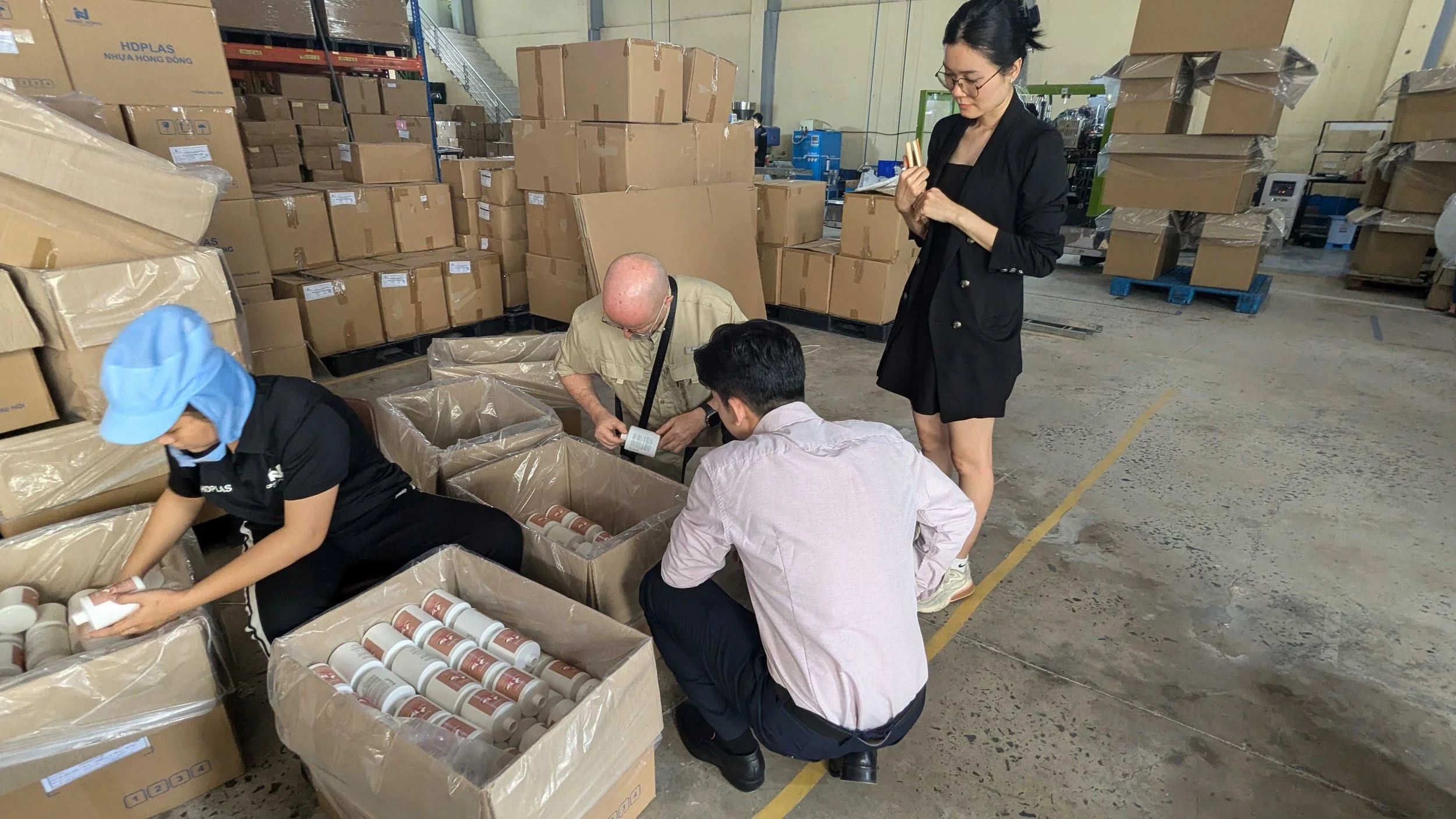
This client of Cosmo Sourcing flew 8,000 miles from the US to inspect his goods at the factory. you can do that too, but do you want to?
Why Overseas Factory Management Is Different from Supplier Management
If you have already read our guide on managing overseas suppliers, you know the fundamentals of building supplier relationships, vetting factories, and setting expectations. Factory management is the next layer down. It is not about finding and evaluating partners. It is about keeping a live production run on track once the PO has been placed.
Supplier management asks: "Is this the right factory?" Factory management asks: "Is this factory making my product correctly, on time, and to spec right now?"
The distinction matters because the skills are different. Supplier management is strategic. Factory management is operational. And most production problems we see come not from choosing the wrong factory but from losing control of the production process after the deposit is paid.
Set Up Communication Rhythms Before Production Starts
Choose One Primary Contact
Every factory has a sales team, a production manager, a QC lead, and sometimes an owner who checks in. You need one primary contact who owns communication for your order. In most Vietnamese and Chinese factories, this is the sales or merchandising contact who placed the order internally. In Mexico, it is often the plant manager who is directly involved.
Get this person's name, direct phone number, and preferred messaging platform before production begins. In Vietnam, Zalo and WhatsApp are standard. In China, WeChat dominates. In Mexico, WhatsApp is universal. Email alone is not fast enough when a production issue needs a same-day decision.
One detail that catches many first-time importers off guard: your sales contact and your production contact may not be the same person. The person who quoted your order may hand it off to an internal production coordinator once the PO is placed. Ask explicitly who will be managing your order on the factory floor, and get introduced to them directly.
Establish a Weekly Update Cadence
Do not wait for the factory to tell you something is wrong. Set a weekly check-in to which your contact sends a brief status update. The update should cover: current production stage, percentage of the order completed, any issues encountered that week, and the projected completion date.
We require this from every factory we manage at Cosmo Sourcing, and even factories that initially resist the structure eventually come to prefer it. A 5-minute weekly update prevents the 2-week silence that ends with "Sorry, we are delayed."
Document Everything in Writing
Verbal agreements made over the phone are not agreements. Every decision regarding materials, color changes, delivery dates, or specification adjustments must be confirmed in writing. A WeChat message counts. A Zalo voice note does not. The goal is a written record you can reference when the finished product does not match what was discussed.
Build a Production Timeline with Milestones
Break the Order into Trackable Stages
A production timeline is not just a start date and an end date. Break it into stages that you can independently verify. For most physical products, the stages look something like this:
Raw material procurement
Sample or pilot run approval
Bulk production starts
Mid-production quality check (in-line inspection)
Bulk production completion
Final quality inspection (pre-shipment)
Packing and loading
Shipment
Each stage should have a target completion date agreed to in writing before production begins. When we manage production for clients, we build this timeline into the purchase order confirmation to avoid ambiguity about what "on time" means.
Understand Realistic Lead Times
One of the most common mistakes we see is buyers accepting a factory's optimistic lead time without questioning it. Factories want your order, and some will quote aggressively to win it.
Here are the realistic lead times we have seen across common product categories in Vietnam:
Garments and apparel: 45 to 75 days from sample approval to shipment, depending on fabric sourcing
Injection-molded plastic parts: 45 to 60 days from sample approval, plus 20 to 30 days for tooling if molds are new
Wood furniture: 60 to 90 days, heavily dependent on wood drying time and finishing complexity
Bags and backpacks: 35 to 55 days for standard constructions
Metal fabrication: 30 to 50 days, longer for custom tooling or specialized finishes
These are working-day estimates and do not include shipping. Add 14 to 18 days for sea freight from Ho Chi Minh City to the US West Coast, or roughly 28 to 35 days to Europe. Factor in holidays carefully. Vietnamese factories typically shut down for 2 to 4 weeks during Tet (Lunar New Year), and Mexican factories slow significantly during the Christmas period.
Monitor Production Quality Before It Ships
Define Quality Standards in Writing Before Production
The single most effective thing you can do for quality control is share your standards in writing before production starts, not after you receive a defective shipment.
Create a quality requirements document (sometimes called a QC checklist or product specification sheet) that covers: acceptable tolerances for dimensions; color references with Pantone codes or physical swatches; packaging requirements; labeling specifications; and a clear list of defects that will cause rejection.
Send this document to the factory before production starts and get written confirmation that they have reviewed it. Ask them to flag any specifications they cannot meet. It is far better to negotiate tolerances before production than to reject a finished order.
We learned this the hard way early on at Cosmo Sourcing. A client sourcing ceramic tableware from a factory in Binh Duong received an order where 15% of the pieces had minor glaze variations. The factory considered them acceptable. The client did not. The problem was not the factory's capability. It was that "acceptable glaze variation" had never been defined in writing. That one project changed how we onboard every production run. Now we require every factory to sign off on a QC checklist before bulk production begins.
Schedule In-Line Inspections
Do not wait until the full order is finished to check quality. An in-line inspection at 20% to 30% production completion catches systemic issues while there is still time to correct them. If a stitching pattern is wrong on the first 200 units, you want to know before the factory completes 2,000.
In-line inspections can be performed by a third-party inspection company, by your own team if you have boots on the ground, or by a dedicated buying office that manages production on your behalf. The key is that someone outside the factory is checking the work while it is still in progress.
Conduct Pre-Shipment Inspection
Before the factory packs and ships, conduct a pre-shipment inspection on the finished goods. The industry standard is to inspect a random sample using AQL (Acceptable Quality Level) sampling tables, typically AQL 2.5 for major defects and AQL 4.0 for minor defects.
Pre-shipment inspection is your last chance to catch problems before the goods are on the water. Once a container is loaded and the bill of lading is issued, your leverage drops significantly.
Handle Production Delays Before They Derail Your Launch
Identify the Most Common Delay Causes
Production delays are not random. In our experience managing production across Vietnam and the rest of Southeast Asia, the same causes come up repeatedly:
Raw material shortages or late delivery from sub-suppliers
The factory took on too many orders and is over capacity
Quality failures during production require rework
Machinery breakdown
Holiday shutdowns that were not factored into the timeline
Shipping disruptions at the port
Most of these are preventable or at least predictable if you are monitoring production milestones weekly rather than waiting for the factory to self-report.
Build Buffer Time into Your Planning
If a factory quotes 60 days, plan for 75. If you need goods by a specific date for a product launch or retail delivery window, work backward from that date and add 2 to 3 weeks of buffer. Experienced buyers treat the factory's quoted lead time as the best-case, not the expected-case.
Escalate Early, Not Late
When a milestone is missed, address it the same week. Do not wait to see if the factory "catches up." In our experience, factories that miss one milestone without intervention tend to miss the next one too. A direct, respectful conversation about the delay and a revised timeline commitment is far more effective than silence followed by frustration.
The tone matters here. In Vietnamese business culture, confrontation can shut down communication entirely. We have found that framing delays as shared problems rather than accusations keeps the factory engaged. "We noticed the raw materials arrived late. How can we adjust the schedule to protect the ship date?" works better than "You missed the deadline."
If you do not have someone on the ground who can visit the factory and verify progress in person, consider working with a sourcing company or a buying office with a local presence. The ability to physically walk into a factory and see the production line changes the dynamic entirely. A factory that knows someone will be visiting next Tuesday operates differently from one that knows the buyer is 12 time zones away.
When to Consider a Dedicated Buying Office
Managing one or two production runs per year from a distance is doable with the right systems. But as order frequency grows, so does the management burden. If you are placing monthly orders, running production across multiple factories, or sourcing products that require tight quality tolerances, the communication and monitoring load can become a full-time job.
The math is straightforward. If you are spending 10 to 15 hours per week managing factory communication, chasing updates, coordinating inspections, and troubleshooting production issues, you are doing the work of a buying office without the local presence to do it effectively. Time zone gaps alone mean that a question asked on Monday morning may not get a factory response until Tuesday.
This is where a dedicated buying office makes sense. A buying office provides a permanent or semi-permanent team in the sourcing country that handles day-to-day factory management, quality control, production monitoring, and logistics coordination on your behalf. It is the difference between managing production from a laptop at 11 pm and having someone on the factory floor that morning sending you photos of the production line.
For brands sourcing from Vietnam, where our team is based in Binh Duong and Ho Chi Minh City, this kind of daily oversight is what turns a supplier relationship from reactive to proactive. Our team visits factories in person, attends in-line inspections, and handles the back-and-forth communication in Vietnamese, so nothing gets lost in translation.
Get Production Management Support
Managing a factory overseas does not have to mean managing it alone. Cosmo Sourcing is a flat-fee sourcing company that helps brands find the right factories, manage production, and maintain quality standards across Vietnam, Mexico, Thailand, Indonesia, and other manufacturing hubs. We provide 2 to 6 quotes from 2 to 6 vetted factories, direct introductions, and ongoing production support with no commissions or markups on your orders.
If you are scaling production and need a team on the ground, reach out at info@cosmosourcing.com or visit cosmosourcing.com/contact-us.