What Is a Certificate of Conformance? A Guide for Product Sourcing
A Certificate of Conformance (COC) is a document issued by a manufacturer or authorized third party confirming that a product meets the quality, safety, or regulatory standards specified in your purchase order or required by the destination country's customs authority. If you are importing products from Vietnam, Mexico, or anywhere in Asia, you will likely need one at some point, and knowing the difference between a legitimate COC and a worthless one can save you weeks of delays at customs.
At Cosmo Sourcing, we have reviewed COCs on thousands of products across dozens of categories. The document itself is straightforward. The problems start when your factory hands you a COC that references the wrong standard, covers "all products" instead of your specific batch, or is clearly a template they reuse for every buyer. This guide covers what a COC is, when you need one, what it should include, and how to avoid the most common problems sourcing buyers encounter.
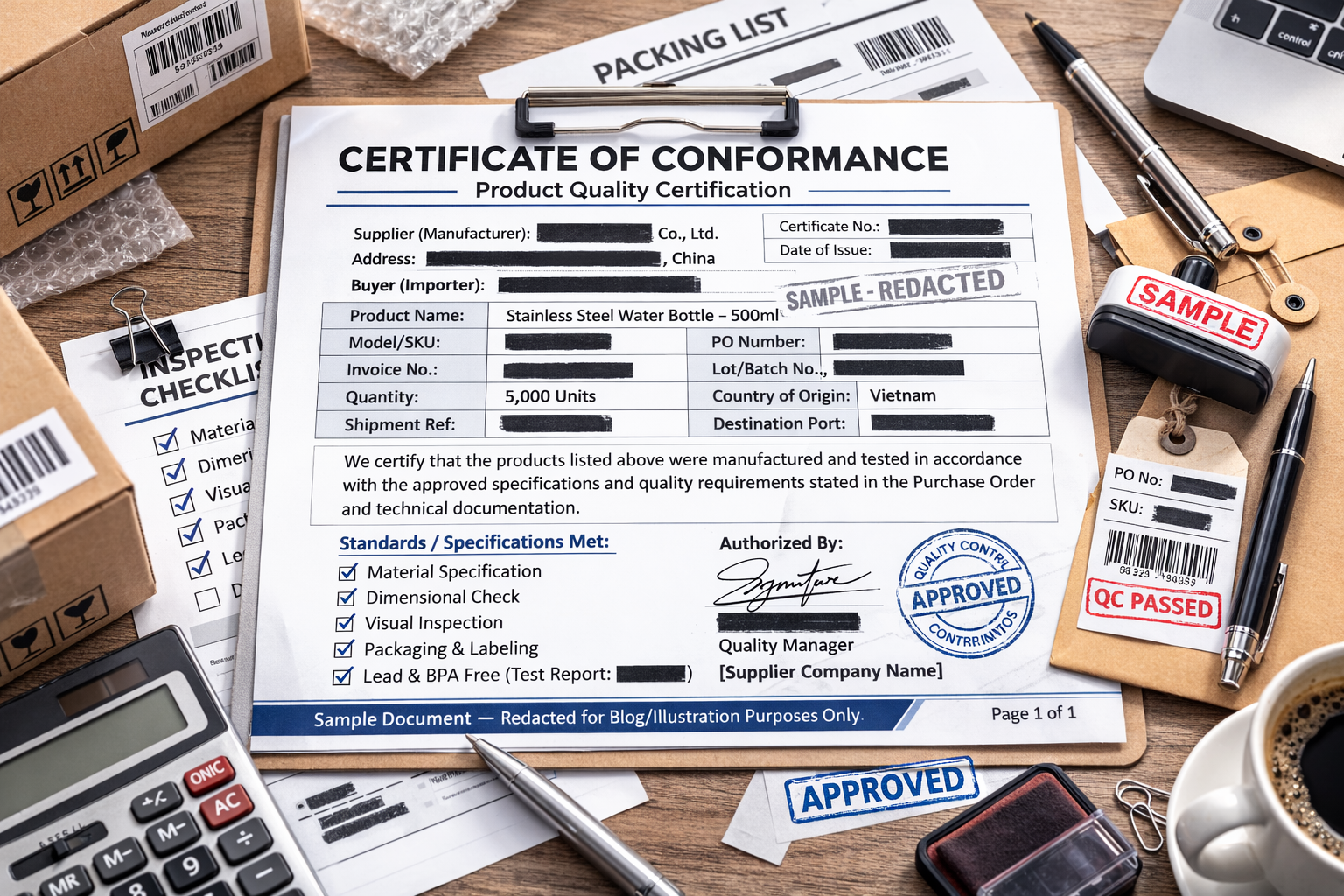
What a COC Actually Is (and What It Is Not)
A COC is a declaration. It states that a specific product, batch, or shipment conforms to a defined set of standards. That is it. It is not test data, a lab report, or proof that independent testing was performed. Understanding this distinction matters because many buyers assume a COC means the product was tested. It may or may not have been.
COC vs Certificate of Analysis (COA)
A Certificate of Analysis (COA) includes actual test data, including measurements, chemical compositions, and pass/fail results against specific parameters. A COC is a declaration of conformance without necessarily attaching the underlying data. If you need proof that a material meets a specific chemical threshold or dimensional tolerance, you need a COA or a test report, not just a COC. For most finished consumer goods, a COC paired with a third-party test report covers your bases. For raw materials, pharmaceuticals, or food ingredients, a COA is typically required.
COC vs EU Declaration of Conformity (DOC)
If you are shipping to Europe, the EU requires a Declaration of Conformity (DOC) for products falling under specific directives (Machinery Directive, Low Voltage Directive, Radio Equipment Directive, among others). A DOC is a self-declaration by the manufacturer that the product meets the applicable EU directive. It is not the same as a generic COC, even though the concepts overlap. The DOC must reference specific EU directives by number and include the manufacturer's name, address, product identification, and the name of the notified body if one was involved. Buyers importing into the EU should not accept a generic COC in place of a proper DOC.
When the Terms "Conformance," "Conformity," and "Compliance" Matter (and When They Do Not)
In practice, "certificate of conformance" and "certificate of conformity" are used interchangeably across most markets. The "Certificate of compliance" appears occasionally, typically in construction and engineering contexts. For import/export purposes, the important thing is not which term appears on the document but whether the document references the correct standards, identifies the correct product, and is issued by the appropriate party. If your customs broker or regulatory authority specifies exact wording, use that. Otherwise, the substance matters more than the label.
When You Need a COC
Products Where a COC Is Legally Required
Certain product categories require conformance documentation as a condition of import. Electronics sold in the US must comply with FCC regulations, and many importers are required to present a Declaration of Conformity or Supplier's Declaration of Conformity at customs. Children's products sold in the US must comply with CPSIA and are subject to third-party testing requirements, with a Children's Product Certificate (CPC) serving as the conformance document. Medical devices require conformance documentation under FDA regulations (US) or the Medical Device Regulation (EU). Food contact materials require documentation demonstrating compliance with FDA 21 CFR (US) or EU Regulation 1935/2004. Import duties and regulatory requirements vary by country, so always check the latest rates and requirements for your specific market.
Products Where a COC Is Not Required but You Should Still Request One
For products without a legal COC requirement, such as general consumer goods, furniture, apparel, and accessories, a COC still serves a valuable purpose. It creates a written record that the factory agreed to produce to a specific standard. If something goes wrong, that document becomes part of your dispute resolution evidence. We recommend requesting a COC on every production order, regardless of whether it is legally required. It costs the factory nothing to issue one, and it establishes accountability.
Country-Specific Requirements
US importers should be aware that Customs and Border Protection (CBP) can request conformance documentation at any time, even for products without a standing COC requirement. EU importers need product-specific documentation that complies with CE marking directives. UK importers now operate under the UKCA marking system post-Brexit, which has its own conformance documentation requirements separate from the EU. Australian importers deal with the Australian Consumer Law and specific product safety standards administered by the ACCC. Middle Eastern markets, particularly in the GCC, often require a Certificate of Conformity through programs such as SABER (Saudi Arabia) or G-Mark (UAE). If you are unsure which documentation your product needs, confirm with your customs broker before production starts, not after shipment.
What a Proper COC Should Include
The 10 Elements Every COC Must Have
A COC that will hold up at customs and protect you in a dispute should include the manufacturer's legal name and address, a description of the product (not a generic category, but the specific item), the applicable standards or specifications the product conforms to, the batch or lot number tying the COC to a specific production run, the test methods or inspection procedures used, the date of issue, an authorized signature (not a stamp alone), the name and credentials of the testing laboratory (if third-party tested), the purchase order number or contract reference, and a validity period or statement of applicability. If any of these elements are missing, the document is incomplete. Send it back.
Red Flags That Indicate a Fake or Worthless COC
This is where most buyers get caught, and where on-the-ground experience matters. We have flagged COCs from factories that listed a standard that the product was never tested against. We have seen documents covering "all products manufactured by [factory name]" with no reference to a specific batch, meaning the same COC could apply to anything the factory has ever manufactured. Other warning signs include a COC issued before production was completed (how can you certify conformance on products that do not exist yet?), no authorized signature or only a company stamp, a testing lab name that does not appear in any accreditation database, and formatting that looks like it was created in five minutes on a word processor with no letterhead.
If the COC your factory provides looks generic, ask for specifics. Request the test report that supports it. If they cannot produce one, the COC is a formality with no substance.
How to Request a COC from Your Manufacturer
When to Request It
Request the COC requirement before production starts, ideally when you issue the purchase order. If you wait until after shipment to ask for one, you have no leverage, and the factory may hand you whatever template they have on file.
What to Include in Your Purchase Order to Make the COC Requirement Binding
Add a clause to your purchase order that specifies exactly which standards the COC must reference, whether the COC must be backed by third-party testing, and which accredited lab must perform the testing (if applicable). That shipment release is contingent on receipt of a compliant COC. This turns the COC from a nice-to-have into a contractual obligation. Without this language, many factories treat the COC as optional paperwork. For guidance on structuring purchase orders and negotiating terms with manufacturers, clear documentation upfront prevents problems downstream.
Self-Issued COC vs Third-Party COC
A self-issued COC is a declaration from the factory that its product meets a standard. A third-party COC involves an independent lab or inspection body verifying conformance. For low-risk products (general consumer goods, non-regulated items), a self-issued COC backed by the factory's internal QC records is usually sufficient. For regulated products (electronics, toys, medical devices, food contact), always require third-party testing and a COC issued or co-signed by the testing lab. The factory's word alone is not enough for customs authorities in most markets.
Working with Testing Labs
The major international testing labs (SGS, Bureau Veritas, Intertek, TUV) all operate in Vietnam and across Southeast Asia. Testing costs vary by product and standard, but expect to pay $200 to $1,500 per product, depending on the complexity of the testing required. Simple physical testing (tensile strength, colorfastness) sits at the lower end. Full chemical analysis or electrical safety testing costs more. You can find a detailed overview of inspection and testing companies operating in Vietnam on our blog.
Common Problems Sourcing Buyers Run Into
Factory Provides a COC That Does Not Reference Your Specific Standards
This happens frequently. You specify ASTM F2057 for furniture tip-over testing, and the factory sends a COC referencing "general safety standards" with no ASTM number. Reject it and send back the specific standard reference from your purchase order. A COC that does not name the exact standard it claims conformance to is functionally useless.
COC Is Generic and Covers "All Products" Rather Than Your Batch
A COC should reference your purchase order number and batch or lot number. If the factory hands you a COC that applies to everything they make, it does not demonstrate that your specific order was inspected or tested. Push back and request a batch-specific document.
Factory Refuses to Provide One or Charges Extra
Some factories, particularly smaller operations, are not accustomed to issuing COCs and may resist the request or try to charge for it. A self-issued COC costs the factory nothing beyond the time to fill out a form. If they charge for it, they are either padding the invoice or confusing a COC with third-party testing (which does have a real cost). Clarify the distinction and make the COC a non-negotiable part of your order terms. Thorough supplier vetting before placing an order helps you identify factories that understand export documentation requirements.
Customs Holds Your Shipment Because the COC Does Not Match the HS Code
This is one of the more painful scenarios. Your shipment arrives at the destination port, customs reviews the documentation, and the COC references a product description or standard that does not align with the declared HS code. The shipment gets held pending clarification, which can take days or weeks, depending on the port. Prevent this by ensuring the product description on the COC matches the product description on the commercial invoice and packing list exactly. Cross-reference the HS code with the standards referenced on the COC before shipment. If you are working with a sourcing company, they should catch this during the pre-shipment documentation review.
It is also worth noting that NNN agreements and other IP protection documents are separate from conformance documentation. A COC addresses product quality and regulatory compliance, not intellectual property. Make sure you cover both categories.
Source with Confidence with Cosmo Sourcing
Getting your COC right is one piece of a larger quality assurance process that starts with finding the right factory and ends with your product clearing customs without delays. At Cosmo Sourcing, we handle the entire sourcing process on a fixed fee, from identifying and vetting manufacturers to reviewing documentation before shipment. We typically provide original quotes from 2 to 6 vetted factories, and you work directly with the manufacturer we connect you with.
We have had our own team in Vietnam since 2014 and in Mexico since 2023. We know what a legitimate COC looks like because we have reviewed thousands of them across every product category. If you are sourcing a product that requires conformance documentation and want to make sure it is done right, reach out at info@cosmosourcing.com or visit cosmosourcing.com/contact-us.