How to Manage Overseas Suppliers Without Your Own Office in Asia
Managing overseas suppliers without a local presence is possible, but only up to a point. Once you are running regular production across multiple factories, the gaps in communication, quality oversight, and timeline accountability start costing you real money. This guide covers the five most common approaches to remote supplier management, how each one breaks down, and when you need someone on the ground.
At Cosmo Sourcing, we have helped thousands of clients manage production across Vietnam, Mexico, Thailand, Indonesia, and beyond. Most of them come to us after trying to manage suppliers on their own for a year or two and hitting a wall. The patterns are remarkably consistent, and understanding those patterns can save you a lot of time.
Quick snapshot: Five approaches to managing overseas suppliers
Managing everything yourself via email and messaging apps
Scheduling periodic factory visits
Hiring a local freelance QC inspector
Working through a trading company or sourcing agent
Using a dedicated buying office with a permanent local team
Each approach works at a certain scale. The question is which one matches where you are right now and where you are headed.
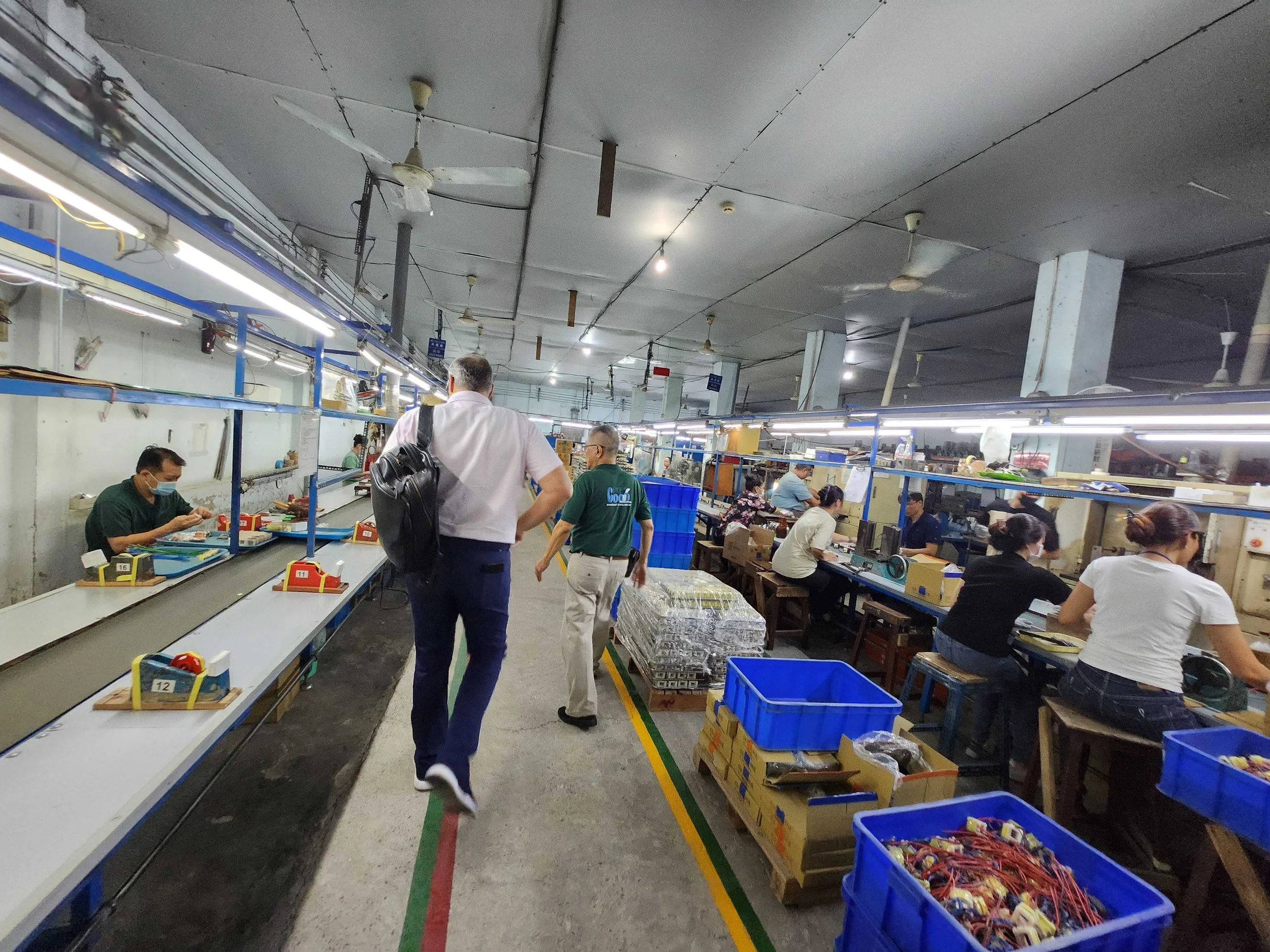
[PHOTO PLACEHOLDER: Jim to provide a photo of the Cosmo team at a factory visit in Binh Duong or HCMC, ideally mid-discussion with factory management. Alt text: "Cosmo Sourcing team reviewing production samples with factory management at a facility in Binh Duong, Vietnam"]
Why Remote Supplier Management Breaks Down
Most buyers start by managing overseas manufacturing themselves. You find a factory on a trade platform, exchange samples, negotiate pricing over email, and place your first order. For a single product with a single supplier, this works well enough.
The problems start when you scale. Here is what we see go wrong most often with our clients:
Communication gaps compound over time
A supplier who responds within 24 hours during the sampling phase may take 3 to 5 days to reply once production is underway. Time zone differences mean you lose a full business day with every back-and-forth. When you are sourcing from Vietnam (GMT+7) and based in North America or Europe, a simple question about thread color or packaging specs can take a week to resolve. We have seen clients lose two to three weeks on a production run because a material substitution was buried in a WeChat message that nobody followed up on.
Quality problems arrive at your warehouse, not at the factory.
Without someone physically checking production at key stages, you only find out about quality issues after the container lands. A client came to us last year after receiving 3,000 units of a custom bag from a factory in Ho Chi Minh City. The stitching on the shoulder straps failed the pull test on roughly 40% of the units. The factory had switched thread suppliers mid-production to save cost. No one was on site to catch it.
Pricing and timeline claims go unverified
When your supplier tells you the lead time is 45 days, that number may include a buffer they built in for their own scheduling flexibility, or it may be optimistic because they have not yet secured raw materials. Without someone who understands local production norms, you have no way to benchmark. For reference, standard production lead times for sewn goods in Vietnam range from 45 to 75 days, depending on complexity, material sourcing, and factory capacity. If a factory quotes you 30 days on a complex order, that is a red flag worth investigating.
Five Approaches to Managing Overseas Suppliers
Managing everything yourself remotely
This is where most importers start. You handle communication, sample approvals, quality expectations, and shipping coordination directly with the factory via email, WhatsApp, WeChat, or Zalo.
When it works: Single supplier, simple product, small order volumes (under 500 units), and you have done business with this factory before.
Where it breaks down: Once you are managing two or more suppliers, running repeat orders, or producing anything with tight tolerances on color, dimensions, or materials. The administrative load alone can consume 10 to 15 hours per week, and you still have zero visibility into what is happening on the factory floor.
Periodic factory visits
Flying to Asia once or twice a year to visit your suppliers, audit production, and build relationships.
When it works: You have a small number of established suppliers, and your product does not require ongoing quality monitoring between orders.
Where it breaks down: A factory visit gives you a snapshot, not a continuous picture. We visited factories in Binh Duong during a scheduled tour, where the production lines looked excellent. Still, the same facility was operating under a completely different quality standard two weeks later when they shifted to another client's order. Factories often prepare for announced visits. The real test is what happens when nobody is watching.
Costs add up quickly, too. A week-long sourcing trip to Vietnam typically costs $3,000 to $5,000 per person, including flights, hotels, local transport, and interpreter fees. Two trips a year is $6,000 to $10,000, and you still have 50 weeks without eyes on production.
Hiring a local freelance QC inspector
Paying a freelancer or inspection agency (QIMA, SGS, Bureau Veritas, or a local independent inspector) to check production at key milestones: pre-production, during production, or pre-shipment.
When it works: You need a specific quality gate on individual shipments. Pre-shipment inspections are useful for catching obvious defects before containers are loaded.
Where it breaks down: Freelance inspectors check what you tell them to check. They follow an inspection protocol for a defined scope, usually during a single visit. They do not manage the supplier relationship, track production timelines, negotiate on your behalf, or flag upstream problems before they become downstream failures. The inspector who checks your pre-shipment sample has no context for why the factory switched adhesive suppliers three weeks into production. They see the output, not the process.
We often work alongside inspection agencies for clients who want both ongoing management and independent third-party verification. They serve different functions.
Working through a trading company
A trading company acts as an intermediary. They place your order with the factory, handle communication, and ship to you. You may never know which factory is actually producing your goods.
When it works: You need a simple product with standard specs, you do not need factory-level customization, and you are comfortable with a middleman controlling the supplier relationship.
Where it breaks down: Trading companies create information asymmetry by design. You do not have a direct line to the factory. You do not control the production schedule. And you often pay an invisible markup because it is baked into the quoted price. When something goes wrong, you are relying on the trading company to advocate on your behalf with a factory you have never spoken to. Their incentive is to keep the order moving, not necessarily to push back on quality issues that would delay shipment.
The other risk: if you ever want to move away from the trading company, you may discover you have no factory relationship at all. The supplier knows the trading company, not you.
Using a dedicated buying office
A buying office is a permanent local team in your sourcing country that manages suppliers, production, and quality on your behalf. Unlike one-off inspections or periodic visits, a buying office provides continuous oversight.
When it works: You are running regular production (monthly or quarterly orders), working with multiple factories, producing products where quality consistency matters, or scaling to a volume where mistakes are expensive.
Where it breaks down: If you only import one product once a year, a dedicated buying office is more infrastructure than you need. For everyone else, it is typically the point where remote management stops being viable and local presence starts paying for itself.
At Cosmo Sourcing, our Dedicated Buying Office service puts a team on the ground in your sourcing region. They handle factory communication in the local language, run production tracking on a daily or weekly cadence, perform in-line quality checks during production (not just at shipment), and serve as your permanent representative with the factory. The factory knows your buying office team by name. That continuity in relationships changes the entire dynamic.
How to Decide What Level of Support You Need
There is no single right answer here. The best approach depends on four factors:
Order frequency and volume
If you place one or two orders a year totaling under $50,000, self-management with an occasional inspection may be enough. Once you place monthly or quarterly orders, or your annual spend exceeds $100,000, the cost of mistakes exceeds the cost of professional management.
Product complexity
A simple, single-material product with generous tolerances (a basic cotton tote bag, a standard cardboard box) is easier to manage remotely than a multi-material, tight-tolerance product (a leather bag with custom hardware, an electronic device with injection-molded housing). The more complex the product, the more points of failure, and the more you need someone who can catch problems during production rather than after.
Quality sensitivity
If your brand depends on consistent quality, or if your product has safety implications, you cannot afford to rely solely on end-of-line inspections. In-process quality monitoring catches problems when they can still be fixed, not after 5,000 units have already been produced.
How many suppliers are you managing
One factory is manageable. Three factories across different provinces or countries require full-time coordination. If you are sourcing across Vietnam and another country, the logistics of managing multiple supplier relationships remotely become unsustainable without local support.
The Transition Most Buyers Make
The typical progression we see with our clients: they start managing everything themselves, hit a quality issue or a costly delay, try adding inspections, realize inspections do not solve the underlying management gap, and then look for a permanent local presence. The clients who come to us earliest in that cycle tend to avoid the most expensive lessons.
If you are at a stage where remote management feels held together by WhatsApp messages and good intentions, it is probably time to explore what a local team on the ground can do for you.
Cosmo Sourcing Puts a Team on the Ground Where Your Products Are Made
Cosmo Sourcing is a flat-fee sourcing company with teams in Vietnam and Mexico. We provide direct factory introductions, ongoing production management, and dedicated buying office services for brands that need a permanent local presence. No commissions, no markups, and no information gatekeeping. You get 2 to 6 quotes from 2 to 6 factories, with direct introductions to each.
Thousands of clients have used Cosmo to find, vet, and manage overseas suppliers. If remote management is not cutting it anymore, let's talk about what local support looks like for your specific products.