Vietnamese Business Culture // A Guide to Working with Suppliers, Communication, and Tet Planning
Working with Vietnamese suppliers means adapting to a relationship-first business culture, an indirect communication style where "yes" often means "we will try," English proficiency that varies sharply between sales and production staff, and a production calendar shaped by Tet. Buyers who get this right build partnerships that last for years. Buyers who treat Vietnam like China lose samples, timelines, and sometimes entire factories.
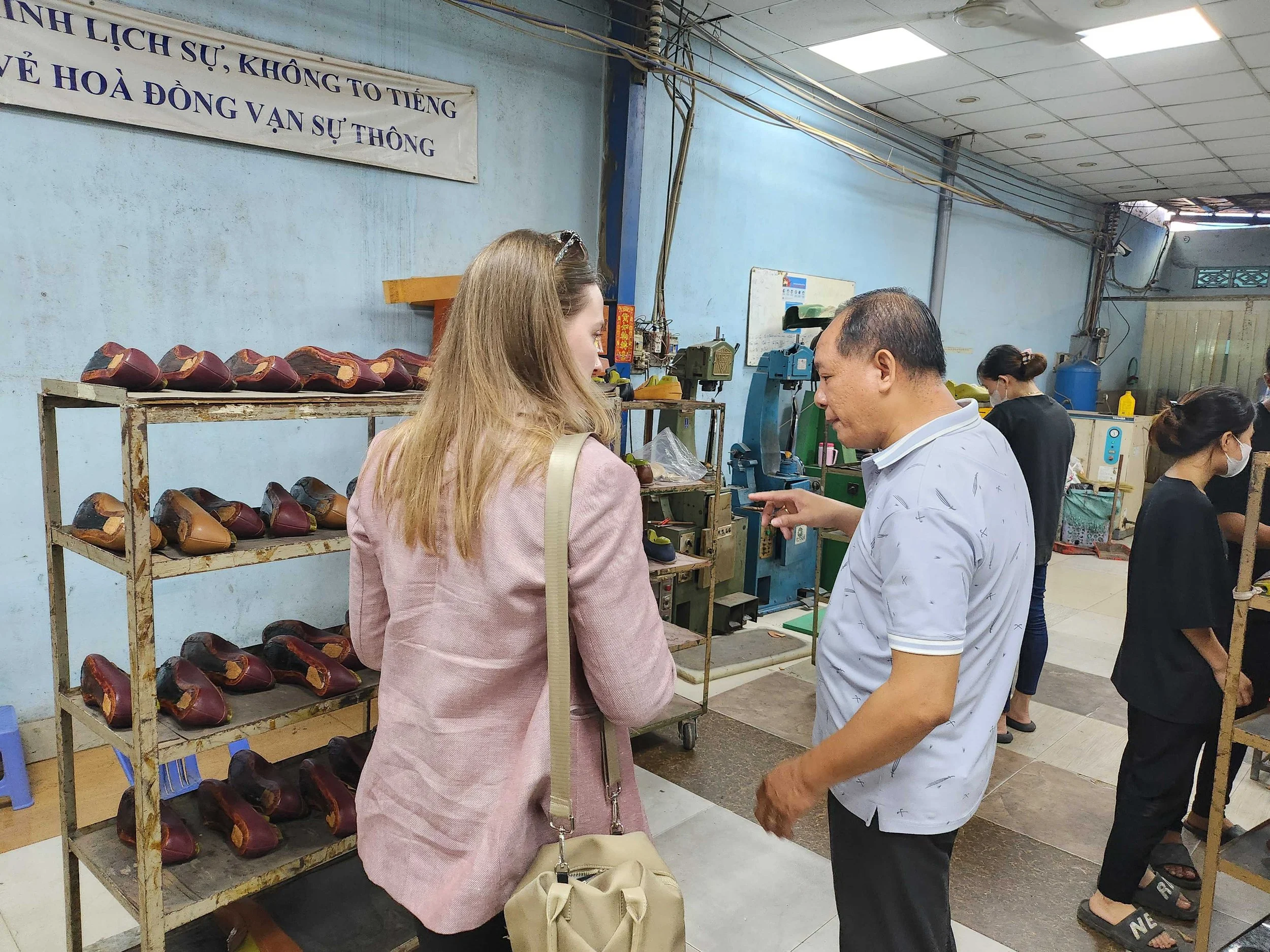
Vietnam Is Not China: What Changes When You Cross the Border
Most buyers I work with at Cosmo Sourcing have experience in China. That experience is a mixed blessing. It teaches you how to read a factory spec sheet, push on MOQs, and structure a sample round. It also teaches you habits that will damage a Vietnamese relationship within the first three emails.
I founded Cosmo Sourcing in Shanghai in 2012. Two years later, I moved the company to Ho Chi Minh City. Since then, my team and I have visited hundreds of Vietnamese factories across furniture, textiles, electronics, and metal fabrication. The lesson I keep learning is that Vietnam rewards different behavior than China does. Cultural fluency, not just price discipline, is what makes sourcing from Vietnam work long-term.
In China, the first email can be transactional. Specs, MOQ, price, lead time. A Chinese factory salesperson will often match that tone and come back with numbers within a day. In Vietnam, the same email gets a polite response, no numbers, and a slow fade. The factory is not ignoring you. They are waiting to see whether you are worth the effort of a quote.
Vietnam has the global trade credentials buyers look for: CPTPP membership, the EU-Vietnam Free Trade Agreement (EVFTA), RCEP, and coastal logistics access from Haiphong to Ho Chi Minh City. What it does not have is the Alibaba-shaped, inquiry-first salesperson culture that China built over two decades. For China-experienced buyers actively moving production from China to Vietnam, the cultural gap is usually the biggest surprise.
Relationship First, Deal Second
Vietnamese business culture is relationship-first. That phrase gets used so often that it has lost meaning, so here is what it looks like on the ground.
A Vietnamese factory owner wants to know who you are before they want to know what you want. Not your company's revenue. Not your purchase order history. You, personally. How do you talk? Whether you listened during the factory tour. Whether you remembered the production manager's name on the second visit. Whether you accepted tea when it was offered or rushed straight into the quote.
This is not performative hospitality. It is risk management. Vietnamese factories have been burned repeatedly by foreign buyers who place a small initial order, squeeze prices, and disappear when a better quote comes in from the next province. The factory owner is reading whether you are that kind of buyer before committing capacity, pricing their best number, or introducing you to the people who will actually run your order.
In my experience, the gap between a factory's email quote and its quote after an in-person lunch is often 10 to 15 percent. The factory is not being dishonest on email. They are holding their best number for a buyer they can read.
The practical consequence: First RFQs often get soft responses. A good quote arrives after the second or third conversation, sometimes only after an in-person visit. If you only ever email, you will get the polite-stranger price. If you show up, the number moves. The same principle applies to how you handle paying a Vietnamese supplier: clean bank wires, no last-minute deposit games, no payment terms the factory has to chase.
Hierarchy: Who to Address and Why It Matters
Vietnamese business is hierarchical in ways that matter for every email, meeting, and negotiation.
Address the senior person first. In most Vietnamese factories, that is the owner (often called the "director" or "general director") or a senior production manager, not the English-speaking sales assistant who responds to your first inquiry. The sales assistant is the doorway. The decision happens elsewhere.
This matters because the Vietnamese hierarchy is also age-sensitive. If the factory owner is 55 and the sales assistant is 27, the sales assistant cannot commit to price adjustments, lead time changes, or production slot reassignments without going back up the chain. Foreign buyers who push the sales assistant harder are not accelerating a decision. They are embarrassing someone who cannot help them. Worse, they are signaling that they do not understand the structure, which is a trust signal in the wrong direction.
The correct move is to politely and early ask to meet or talk with the person who decides on your order. Vietnamese factories respect that request. They do not volunteer it.
My Vietnam team in Binh Duong prepares client introductions for every first visit. It sounds small, but getting the seniority order right in the first five minutes sets the tone for every meeting after. When you are introduced to a group at a factory, the most senior person is greeted and handed a business card first. In meetings, the senior person speaks first and is listened to in silence. Cutting in, even helpfully, resets trust.
How to Read a Vietnamese Factory's "Yes"
In Vietnamese factories, "yes" is often "we will try." Sometimes it is "we heard you." Occasionally, it is "we do not want to contradict you here, we will discuss it after you leave." It's rarely the unconditional "confirmed" that Western buyers hear.
This is the single most expensive misunderstanding in first-year Vietnam sourcing. A buyer asks whether the factory can hit a 60-day lead time on a new product. The production manager says yes. The buyer confirms the order. The sample takes 80 days. Nobody lied. The production manager said what was culturally acceptable at the time: "We understand what you are asking, and we will work toward it." The foreign buyer heard a commitment.
The way I navigate this with Cosmo clients is to ask the same question three different ways, at different points in the conversation, and listen for the hesitation.
"Can you produce 5,000 units of this in 60 days?" A quick yes is unreliable.
"What is the longest part of the production for this item?" If the answer is "dyeing" or "sourcing the hardware" or "the second sampling round," you now have a real data point.
"If the first 1,000 units are ready in 40 days, can we inspect them before the rest run?" A yes here, with specifics, is closer to a real commitment.
After 14 years sourcing from Asia and 12 years running Cosmo Sourcing's Vietnam operation from Binh Duong, the shortest way I put this to clients is: if the factory agrees to the first answer you propose, you have not negotiated anything. You have confirmed that they are being polite. Reading Vietnamese, yes, is part of a broader discipline, and properly negotiating with Vietnamese suppliers is worth studying separately.
English Proficiency in Vietnamese Factories: The Real Picture
English proficiency in Vietnamese factories varies more than most foreign buyers expect. It does not vary evenly. It varies by role.
Sales staff, especially at export-focused factories, often have strong conversational English. They will handle the first Zoom call confidently. Production managers, QC leads, and floor supervisors, the people who will actually run your order, usually have much weaker English. Some have none.
I have walked through factory floors in Binh Duong where the salesperson had a polished English LinkedIn profile, and the production head could not tell me what fabric was on the cutting table. That is not unusual. It is the default.
The practical implication: the RFQ stage feels smooth, and the execution stage is where translation gaps cost you money. A foreign buyer can go six weeks thinking production is on track because every email with the sales team reads well. The sales team, meanwhile, has been softening production-floor reality in translation.
The hedge I use with every Cosmo client is to insist on written specifications with photos and diagrams, not just text. Confirm critical details (fabric weight, box dimensions, material grade) in both English and Vietnamese on the purchase order. Get at least one conversation with the production manager on the floor, translated if necessary, before approving a sample.
Foreign-owned factories (covered in the next section) usually have stronger English across roles because the owner company enforces it. Vietnamese-owned factories do not.
Foreign-Owned vs Vietnamese-Owned Factories
One of the first decisions a Vietnam buyer makes, usually without realizing it, is whether to source from a foreign-owned factory operating in Vietnam or a Vietnamese-owned factory. The two operate very differently, and the right choice depends on your order profile.
Foreign-owned factories in Vietnam are typically Taiwanese, Korean, or Japanese, sometimes Chinese. They came in during the 1990s and 2000s FDI wave and now dominate several sectors, especially electronics, footwear, and higher-end garments. They run on the owner country's management systems. Vietnamese-owned factories are more common in furniture, handicrafts, textiles, metal fabrication, and lower- to mid-tier apparel.
Here is how they differ for the foreign buyer:
| Factor | Foreign-Owned | Vietnamese-Owned |
|---|---|---|
| Production systems | Tighter, more formalized | Looser, more flexible |
| English proficiency | Usually strong on sales and merchandising | Often limited to one contact |
| Western QC experience | Higher | Variable |
| MOQ flexibility | Higher MOQs, less flex | Lower MOQs, more flex |
| Custom spec flexibility | Limited | High |
| Pricing on comparable items | Tighter margins, less room | Often more competitive |
| Payment processes | Standardized (bank wires, Incoterms) | Less standardized, more negotiation |
| Relationship dependency | Moderate | High |
Either is better. When my team and I size up a factory match for a client, the first question I ask is which type of factory fits the order, not which has the lowest unit price. A brand shipping 50,000 units of a consumer electronics product will almost always fit better in a Korean-owned factory in Bac Ninh. A Kickstarter founder with a 500-unit order of custom lacquerware will fit better in a Vietnamese-owned workshop in Binh Duong or Thu Dau Mot. MOQs in both columns move more than the table suggests once the factory has met you, walked you through production, and decided you are worth planning around.
Tet: What It Is, Why It Matters, and How to Plan Around It
Tet, the Vietnamese Lunar New Year, is the single largest operational event in the Vietnamese production calendar. More than any other factor, Tet is what separates buyers who have sourced from Vietnam once from buyers who have sourced from Vietnam for years. The difference is not whether they know Tet exists. The difference is whether they planned for it in September.
When Tet Falls
Tet falls on the lunar new year, so the date shifts each year in the Western calendar. Most years, it lands between late January and mid-February. The dates for the next several years are public: 2026 was in mid-February, 2027 is in early February, and 2028 is in late January. Check the calendar when you plan, because "Tet is in February" is not reliable enough to build a production schedule on.
How Long Factories Actually Close
The government-mandated Tet holiday is typically 5 to 7 working days. Factories do not close for 5 to 7 working days. The official standard shutdown is 2 weeks for most factories I work with in Vietnam, though some run longer depending on the workforce and region.
Workers travel home for Tet, often a multi-day journey each way. Factories accept the extended shutdown because fighting it is pointless. Production does not resume until the workforce has celebrated the holiday with their families and returned.
The Post-Tet Lull
Tet is also the year's largest workforce turnover event. Factories do lose workers after Tet, some of whom do not come back and take jobs closer to home instead. Factories replace them, but there is a training lull while new staff come up to speed. A factory that ran well in December often runs more slowly in March, not because management has changed but because a portion of the line is still being trained.
In practice, this means buyers who push for first production right after Tet often get slower output and more quality issues than buyers who wait until April or May. The lull is predictable, and planning around it is cheaper than fighting it.
The "Confirm by October" Rule
Because the Tet effect is so predictable, it is also plannable. The rule I follow with Cosmo clients is: confirm all pre-Tet production by October, do not try to adjust orders in December, and do not schedule critical first-run production in the four weeks after Tet.
October is early enough to lock in materials, sampling, and factory capacity before the factory's own planning goes into Tet mode. In December, every factory is already finalizing what will ship before shutdown; new orders are deprioritized, and changes to existing orders receive informal "yes" responses that do not translate into action.
For buyers shipping just before Tet, I also explicitly included quality control in Vietnam in the timeline. One inspection at 50 percent production and one at 100 percent before the Tet line stops is worth more than a rushed audit the week of shipment.
What Buyers Who Get This Right Do Differently
The buyers I see build long-term Vietnam supplier relationships, the ones still ordering from the same factory five years later, share a small set of habits.
They visit. Not once. Once a year, ideally more. Visiting manufacturers in Vietnam requires a distinct skill set and is best planned carefully on the first trip. They ask questions about the factory and the production manager's family, and they remember the answers.
They treat the first order as an investment in the relationship, not a transaction. They do not squeeze the last dollar out of unit cost in round one. They let the factory win the first project, so the factory wants to win the fifth.
They adjust their calendar to Tet, not the other way around. They will confirm by October. They inspect before shutdown. They do not run the first production in March.
They use the RFQ stage to build trust, not just to collect prices. They ask specific technical questions. They send clear spec sheets with drawings. They confirm in writing, in Vietnamese where possible, on anything that has to be precise.
This is what my Vietnam team does for Cosmo clients every week from our Binh Duong office. We visit factories, run RFQs in Vietnamese, read the hesitation behind a "yes," and plan around Tet. For foreign buyers who do not have that infrastructure on the ground, working with a Vietnam sourcing company is the shortcut to getting this right on the first order instead of the third.
Frequently Asked Questions
Do I need to speak Vietnamese to work with Vietnamese suppliers?
No. Most export-focused Vietnamese factories have English-speaking sales staff. However, English proficiency on the production floor is often limited, and critical specifications should be confirmed in Vietnamese on the purchase order. Working with a local partner closes the gap at the floor level.
When should I visit a Vietnamese factory?
Before your first order, if at all possible, and at least annually after that. Factory visits are the core of relationship-building in Vietnam. A good visit moves the price, the MOQ, and the lead time in ways no amount of email can.
Should I source from a Vietnamese-owned factory or a foreign-owned factory?
It depends on your order. Foreign-owned factories (typically Taiwanese, Korean, or Japanese) are well-suited to larger orders where MOQ is not a barrier. Vietnamese-owned factories handle smaller, custom, or flexible-spec orders and build deeper personal relationships. Both have a place in a mature Vietnam sourcing strategy.
How far in advance should I plan for Tet?
Confirm pre-Tet production by October of the preceding year. Do not schedule critical first-run production for the four weeks after Tet. Build an inspection into the week before shutdown. Missing these deadlines costs more than any other single scheduling error in Vietnam.
Work With Cosmo Sourcing on Your First Vietnam Order
Vietnam rewards buyers who invest in the relationship. Cosmo Sourcing is a fixed-fee sourcing company: no commissions, no markups, no hidden factory-side fees. On a typical project, my Binh Duong team delivers 2 to 6 original factory quotes with full contact details and direct introductions to the factories we recommend. We have been running this Vietnam playbook since 2014.
If you are about to engage a Vietnamese factory, or if a supplier relationship has started to drift, email info@cosmosourcing.com or reach out via cosmosourcing.com/contact-us to talk through your project.