How To Visit Manufacturers In Vietnam // Vietnam Sourcing Trips Guide
Visiting factories in Vietnam is the single best way to verify a supplier, build trust, and make confident sourcing decisions. A well-planned trip typically takes three to five days in-country, during which you can tour four to six factories, meet management teams, and see production firsthand. This guide covers everything you need to plan that trip: visas, transport, accommodation, what to evaluate on the factory floor, and how to make the right supplier decision afterward.
I have been based in Vietnam since 2014 and have personally accompanied hundreds of clients on factory visits across Ho Chi Minh City, Binh Duong, Dong Nai, and beyond. The advice in this guide comes from years of doing this work on the ground.
Updated Feb 17, 2026

Why Visit Factories in Vietnam
Emails, video calls, and sample shipments can only tell you so much. Walking a production floor reveals things no document can: how clean and organized the facility is, how workers interact with management, whether machinery is maintained or neglected, and whether the factory is actually producing what they claim.
Most of our clients visit factories at one of two stages. The first and most common is before placing a purchase order, when they want to compare the shortlisted suppliers we have found for them. The second is during or just after production, to inspect quality and meet the team managing their order.
You do not need to visit Vietnam to source products. Many clients work with us entirely remotely and get excellent results. But if you are placing a large order, building a long-term supplier relationship, or sourcing a complex product, a visit is worth the investment.
When to Visit
The best time to visit is after you have narrowed your supplier list to three to six factories, but before you commit to a purchase order. At this stage, you have enough information to ask informed questions, and the visit becomes a decisive evaluation rather than an open-ended tour.
A typical visit schedule covers two to three factory visits per day over two to three days. That pace gives you enough time at each facility without burning out. I encourage clients to schedule visits in the morning so there is time for follow-up conversations in the afternoon.
Avoid scheduling trips during Tet (Vietnamese Lunar New Year, usually late January to mid-February). Factories shut down for one to three weeks, and many workers travel to their hometowns. The weeks immediately before and after Tet are also less productive, as factories rush to complete orders or ramp back up.

Members of the Cosmo Team with a Client during a visit to a factory in Vietnam!
Vietnam Visa Requirements
US citizens must have a valid visa to enter Vietnam. The easiest option for most visitors is the e-visa, which you can apply for online through the official Vietnam government portal at evisa.gov.vn.
Here is what you need to know about the e-visa process:
Apply online at the official portal. Processing typically takes three to five business days.
The e-visa is valid for up to 90 days. Single-entry and multiple-entry options are available.
You will need a passport valid for at least six months beyond your arrival date, a passport-sized photo (4x6 cm, white background, no glasses, .jpg format), and a clear scan of your passport data page.
Print the approved e-visa before traveling. Present it with your passport at immigration.
Government fees are $25 USD for a single entry or $50 USD for multiple entries.
A tourist e-visa is acceptable for visiting factories. You do not need a business visa for supplier meetings and factory tours. If you do need a business visa for other reasons, let us know, and we can help arrange a sponsor invitation letter, though availability is limited.
Important: Only apply through the official government website. Third-party visa services charge higher fees and occasionally cause problems. Also, double-check that every detail on your application exactly matches your passport. Even small discrepancies (a missing middle name, a typo) can cause delays or entry denial.
Citizens of other Western countries follow a similar process. Check the official portal for your country's specific requirements.
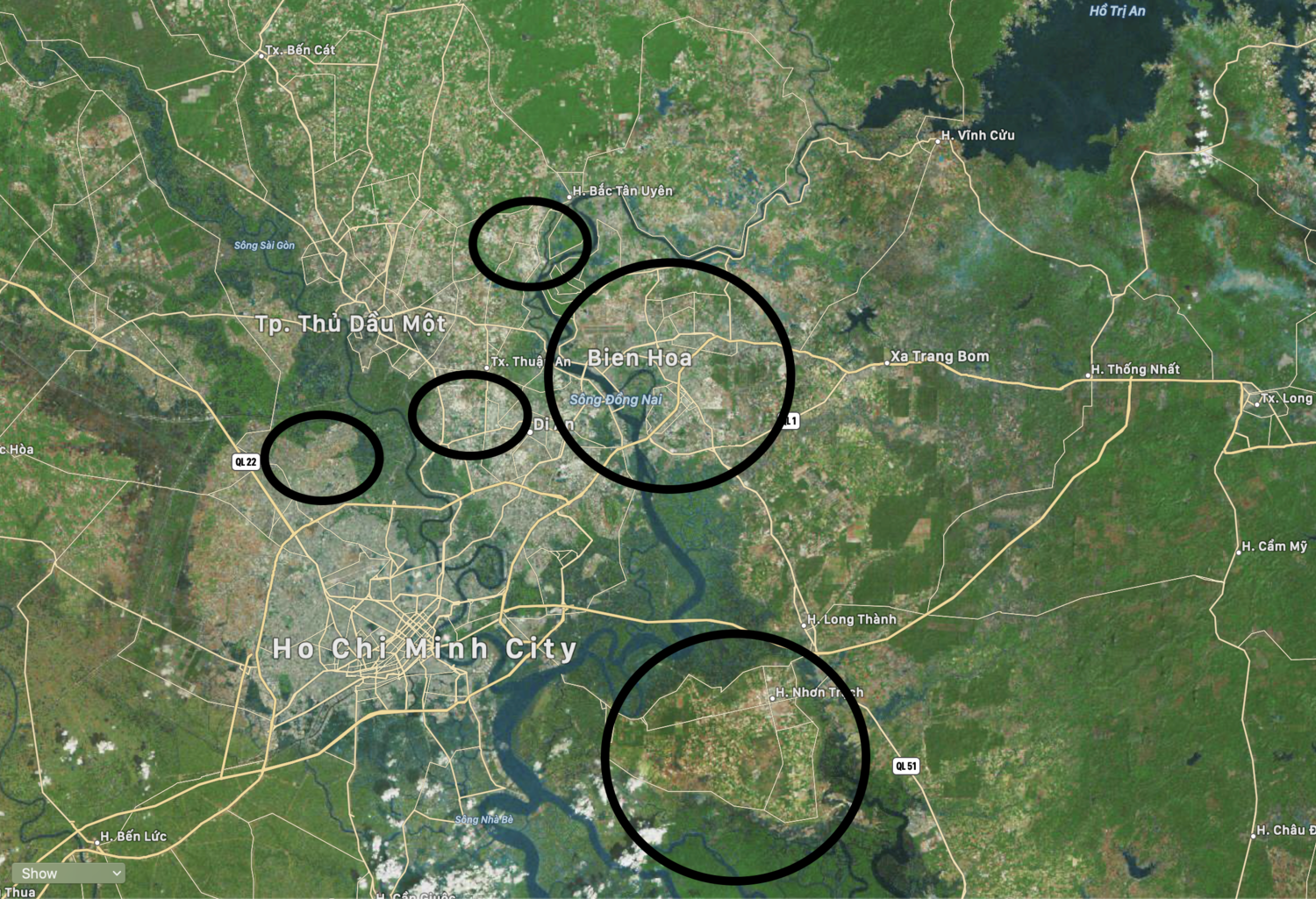
Areas with large amounts of Factories are circled.
Where the Factories Are
Most manufacturing in Vietnam is concentrated around three main areas:
Ho Chi Minh City and the surrounding provinces handle the largest share of export manufacturing. The factories themselves are rarely within Ho Chi Minh City proper. Instead, they cluster in Binh Duong, Dong Nai, and Long An provinces, all 30 minutes to two hours from the city center. You can comfortably visit a factory and return to your hotel in half a day.
Hanoi and the northern provinces are strong in electronics, components, and some textiles. Samsung, Foxconn, and other major manufacturers have large operations in Bac Ninh, Hai Duong, and Thai Nguyen.
Da Nang and central Vietnam are emerging manufacturing hubs, particularly for light industries and some furniture production.
For most product categories, you will be based in Ho Chi Minh City. It offers the broadest range of factories across textiles, furniture, bags, footwear, plastics, packaging, electronics assembly, home goods, and more.
Getting Around
Local taxis and Grab (Southeast Asia's equivalent of Uber) are readily available for getting around the city. But for factory visits, hire a car and driver. I cannot stress this enough.
Do not try to drive yourself. Traffic in Vietnam is chaotic. Scooters dominate the roads, traffic signs are treated as suggestions, and the driving logic takes years to internalize. Vietnam has a high rate of traffic fatalities, and a car with a driver is the safest and most efficient option.
Here are typical rates for a car and driver (12-hour day, up to 100-200 km included):
Sedan (Mazda 3 or similar, seats 4): $40-50 USD
Minivan (Kia Sedona or similar, seats 6): $60-80 USD
Large van (seats 10+): approximately $100 USD
Longer distances or extended hours cost extra. We have contracts with multiple driver services and can help clients compare rates.
If you are more adventurous, you can rent a motorbike. I ride one regularly. But I do not recommend it for first-time visitors.

Where to Stay in Ho Chi Minh City
Most of our clients stay in District 1 (the city center) or District 3. Both districts are close to restaurants, shops, and convenient pickup points for factory visits. Here are the options our clients book most often:
Marriott Renaissance Riverside and Le Meridien are the two most popular choices. Both sit on the riverfront in the heart of District 1 and offer reliable business-class amenities. Good picks if you want Western-standard comfort. Both accept Marriott/Bonvoy points.
Hotel Majestic Saigon is a historic hotel built in the 1920s during French colonial rule. It gained fame during the war as a journalists' base. The rooms are dated, but the Art Nouveau character is genuine.
Villa Song is a small boutique hotel in the Thao Dien neighborhood, a popular area for expats. It is quieter than downtown and closer to the factory zones in Binh Duong and Dong Nai. A good choice if you prefer a more relaxed atmosphere and do not mind being further from the tourist center.
Airbnb is popular and affordable. Two-bedroom apartments throughout the city are easy to find. For longer stays, this is often the best value.
In general, look for accommodations in District 1 or District 3 for the best balance of convenience and access.
What to Eat
Vietnamese food is one of the highlights of visiting. It is affordable, fresh, and exceptionally good. Do not skip the local cuisine. Some dishes to try:
Pho: The famous noodle soup. Get it for breakfast as the locals do.
Banh Mi: Vietnamese sandwich with meats, pickled vegetables, chili, and pate on a fresh baguette.
Bun Thit Nuong: Vermicelli noodles with smoky grilled pork, herbs, and sauce.
Com Tam: Broken rice with grilled meat, a fried egg, and vegetables. Cheap and satisfying.
Banh Xeo: Savory Vietnamese crepe/pancake.
If you have time, book a food tour with a local guide. It is one of the best ways to experience the cuisine and discover dishes you would never find on your own.
Factory managers love it when visitors engage with Vietnamese culture. One of the first things they will ask is what you have tried, where you have been, or what dishes you have eaten. Have a good answer ready. It builds rapport and shows genuine interest.

Me eating Bun Thit Nuong and a coconut
Understanding Vietnamese Business Culture
If you have sourced from China, you are probably familiar with guanxi, the network of relationships built on trust and face-saving. Vietnam does not have an equivalent cultural concept. Business interactions tend to be more casual and direct than in China.
This catches many clients off guard. Some interpret the relaxed attitude as a lack of interest or professionalism. That is not the case. Vietnamese factory owners and managers are serious about their business. They operate with less formality than their Chinese counterparts.
A few things to keep in mind:
Expect slower response times than you are used to with Chinese suppliers. In Vietnam, most factories do not have dedicated sales teams. Engineers and production managers handle inquiries as a secondary responsibility. At Cosmo, we budget up to two weeks for RFQ responses and follow up aggressively on clients' behalf.
Relationships matter, but they are built through direct, honest interaction rather than elaborate protocols. Show up prepared, ask good questions, and be straightforward about your needs and expectations.
Add a few extra days to your trip if you can. Experiencing Ho Chi Minh City, trying the food, and exploring the culture will give you context that makes your business interactions more productive. I have been here for over a decade and remain fascinated by the culture.
What to Look for During a Factory Tour
A factory visit is not a formality. It is a structured evaluation. Here is what to pay attention to:
Production flow and organization. Walk the floor from raw materials intake through finished goods. Is the workspace organized? Is the material properly labeled and stored? A clean, well-organized factory floor is one of the strongest indicators of management quality.
Quality control processes. Look for QC stations at multiple points in the production line, not just final inspection. Ask to see their defect-tracking records, reject rates, and how they handle non-conforming products. Ask what happens when a defect is found mid-production.
Machinery and capacity. Check whether the equipment matches the factory's claims. Are machines modern and well-maintained, or outdated and patched together? Ask about current capacity utilization and how they would scale for your order.
Workforce and conditions. Observe working conditions, safety equipment, ventilation, and lighting. Note the general demeanor of workers. Ethical sourcing matters, and floor conditions tell you a lot about how the factory operates. Ask about labor practices and compliance with international standards.
Certifications and documentation. Ask to see relevant certifications (ISO 9001, ISO 14001, BSCI, WRAP, or industry-specific standards). A factory that invests in certification is signaling a commitment to process and accountability.
Communication capability. Assess how well the factory communicates in English or through a translator. Clear communication is essential for ongoing production management. Language barriers that seem minor during a visit can become serious problems during a production run.
Prepare a list of questions before your visit. Cover production timelines, MOQs, scalability, lead times, payment terms, and how they handle quality issues. The more specific your questions, the more useful the visit will be.
How Cosmo Sourcing Supports Factory Visits
One of our core services is factory introductions and trip planning. Here is what that looks like in practice:
Before your trip, we take your product requirements, research the market, and identify suitable factories. We screen each factory for production capacity, export experience, relevant certifications, and track record. We then present a shortlist with detailed profiles and can obtain quotes in advance, so you arrive ready to have productive conversations.
During your trip, we arrange a car and driver, provide a bilingual team member to accompany you, schedule all factory appointments, and manage the logistics. Our team facilitates communication with factory personnel, helps you ask the right technical questions, and provides context on what you are seeing. We typically schedule two to three factory visits per day and ensure the itinerary maximizes your time.
After your trip, we help you evaluate what you saw, compare factories against your criteria, and make a decision. If you are ready to move forward, we can manage the supplier relationship, oversee production, handle quality control inspections, and coordinate shipping.
If you cannot travel to Vietnam, we also offer virtual factory visits where our team visits on your behalf, provides live video, documentation, and a detailed report.
This service is designed to let you work directly with factories while having an experienced team on the ground to support every step. We provide original factory quotes with no markups. You get direct introductions and contact information for every factory. We work with you or for you, depending on how much involvement you want.
After the Visit: Making Your Supplier Decision
The real work begins after you leave the factory floor. Here is a practical framework for evaluating what you observed:
Compare against your requirements. Review each factory against the criteria you defined before the trip: product capability, quality standards, capacity, pricing, and communication. Do not rely on gut feeling alone. Write down your observations while they are fresh.
Weigh tradeoffs honestly. No factory is perfect. One might have better pricing but weaker QC. Another might have excellent quality but limited capacity. Decide which factors are non-negotiable for your product and which ones you can manage around. For guidance on evaluating trade-offs between Vietnam and China, see our detailed comparison guide.
Start with a sample order. Before committing to a full production run, place a sample or small trial order. This tests the factory's actual performance under real conditions: communication speed, sample quality, adherence to specs, and lead-time accuracy.
Establish clear terms. Before placing a purchase order, formalize expectations around quality standards, inspection rights, payment terms, delivery timelines, and IP protection. Use proper supplier agreements and NDAs or NNN agreements.
Plan for ongoing relationship management. A factory visit is the start of a relationship, not the end of a process. Regular communication, periodic inspections (in person or through a local team), and clear feedback loops help maintain consistent quality over time.
Types of Factories You Can Visit in Vietnam
Vietnam's manufacturing base spans a wide range of product categories. Here are the sectors where we regularly arrange factory visits:
Textiles and apparel (everyday wear, activewear, specialized garments), furniture (wood and metal, residential and commercial), bags and luggage (backpacks, handbags, travel accessories), footwear (casual, formal, athletic, sandals), electronics and components (consumer electronics, PCB assembly), leather goods (wallets, accessories, belts), plastics and rubber products (household items, industrial parts, packaging), toys and games, automotive parts and accessories, home decor and handicrafts (ceramics, textiles, traditional Vietnamese crafts), packaging materials, and medical devices.
For a broader look at what Vietnam manufactures, see our complete Vietnam sourcing guide. To find suppliers online before your visit, check our guide to supplier platforms and resources for Vietnam.
Plan Your Vietnam Factory Visit with Cosmo Sourcing
We have been arranging factory visits and sourcing products in Vietnam since 2014. Our team in Ho Chi Minh City has helped over 4,000 clients across every product category, from Fortune 500 companies to first-time importers.
We operate on a flat-fee model with no commissions or markups on factory quotes. You get original pricing, direct factory introductions, and a team that works transparently on your behalf. Check our pricing page for details.
Whether you want us to plan your entire trip or just need factory introductions, we can tailor our support to what you need.
Email us at info@cosmosourcing.com or visit cosmosourcing.com/contact-us to get started.