Incoterms Defined: What does EXW, FCA, FOB, DAP, DPU, DDP, CPT, CIP, CIF, CFR, or FAS Mean?
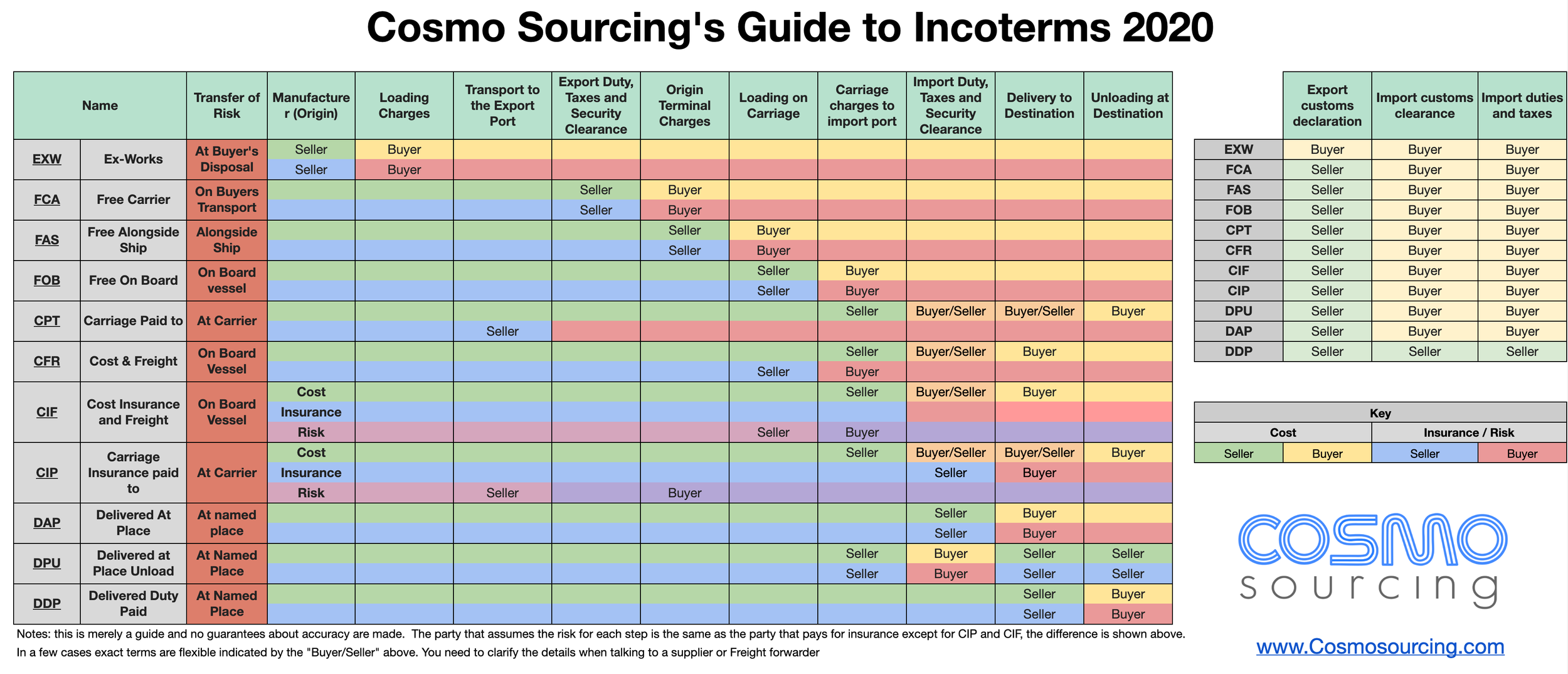
Incoterms are standardized three-letter shipping terms that define who is responsible for costs, risk, and logistics at each stage of an international shipment. Published by the International Chamber of Commerce (ICC), the current Incoterms 2020 include 11 terms ranging from EXW (seller does the bare minimum) to DDP (seller handles everything). EXW and FOB are by far the most common terms you will encounter when sourcing products from Asia.
If you have ever received a supplier quote ending in three mysterious letters, this guide breaks down exactly what each term means, who pays for what, and which terms actually matter when you are sourcing products overseas.
Quick Reference: All 11 Incoterms at a Glance
| Incoterm | Full Name | Seller Responsible Through | Transport Mode |
|---|---|---|---|
| EXW | Ex Works | Factory door | Any |
| FCA | Free Carrier | Export carrier/port | Any |
| CPT | Carriage Paid To | Import port (cost only) | Any |
| CIP | Carriage and Insurance Paid To | Import port (cost + insurance) | Any |
| DAP | Delivered at Place | Buyer's destination (not unloaded) | Any |
| DPU | Delivered at Place Unloaded | Buyer's destination (unloaded) | Any |
| DDP | Delivered Duty Paid | Buyer's door (everything) | Any |
| Sea and Inland Waterway Only | |||
| FAS | Free Alongside Ship | Alongside vessel at export port | Sea/inland waterway |
| FOB | Free On Board | Loaded on vessel at export port | Sea/inland waterway |
| CFR | Cost and Freight | Import port (cost only) | Sea/inland waterway |
| CIF | Cost, Insurance, and Freight | Import port (cost + insurance) | Sea/inland waterway |
The first seven terms apply to any transport mode. The last four apply specifically to sea and inland waterway shipments. In practice, FOB and EXW dominate product sourcing from Vietnam and China. Most of the others rarely come up unless you are working with specialized logistics arrangements.
How Incoterms Work in Practice
Every international shipment involves roughly ten steps: transport to the export port, loading, export clearance, main carriage (ocean or air), unloading at the import port, import clearance, duties and taxes, onward transport, and final delivery. Incoterms define where the seller's responsibility ends, and the buyer's begins.
Two key concepts to understand: "delivery" is the point at which risk transfers from seller to buyer, and "free" describes how far the seller must deliver the goods before the buyer takes over. When a supplier quotes you a price with an Incoterm attached, they are telling you exactly what that price covers and where their obligations stop.
At Cosmo Sourcing, when we request initial quotes from factories on behalf of our clients, we always ask for both EXW and FOB pricing. The EXW price indicates the product's cost at the factory gate. The FOB price tells us what it costs to get the product to the nearest port, providing a baseline for comparing freight-forwarding quotes. The majority of our projects ship FOB.

The Terms That Matter Most: EXW, FOB, and DDP
EXW: Ex Works
EXW is the most basic Incoterm. The seller makes goods available for pickup at their facility, and the buyer is responsible for everything from that point forward, including export clearance, transport, insurance, import clearance, and delivery.
When you get initial quotes from a factory, they will almost always quote EXW unless you ask for something else. This is their lowest price, which makes their numbers look more competitive when comparing quotes across suppliers. On Alibaba, listed prices are nearly always EXW.
The practical issue with EXW is that the buyer becomes responsible for export procedures in a foreign country, which can be complicated. For most importers, FOB is a better starting point because it keeps the export-side logistics with the seller, who is better positioned to handle them.
FOB: Free On Board
FOB means the seller delivers the goods loaded onto the vessel at the named port of shipment. The seller handles everything on the export side: packing, inland transport to the port, export customs clearance, and loading. Once the goods are on the ship, the buyer takes over.
FOB is the most widely used Incoterm in product sourcing for several reasons. The export port is a natural handoff point because freight forwarders typically operate from major ports and can pick up your cargo there. It is also a convenient location for third-party inspection services to verify your goods before they ship. The seller handles all activities within their own country, and the buyer handles everything once the goods leave. That division is clean and practical.
When getting FOB quotes, always confirm which port the supplier is quoting from. "FOB Ho Chi Minh City" and "FOB Hai Phong" can result in different inland freight costs from the factory.
DDP: Delivered Duty Paid
DDP places maximum responsibility on the seller. The seller handles export clearance, main carriage, import clearance, duties, taxes, and delivery to the buyer's specified location. The buyer only needs to receive the goods.
We often get asked why we do not arrange every project as DDP, since it sounds like the easiest option for the buyer. There are several reasons. With DDP, the seller chooses the shipping company and route, and they will not necessarily pick the cheapest or most reliable option. You are also placing significant trust in the seller to handle import customs correctly in your country. If you want to explore DDP, I recommend getting a DDP quote from your supplier, an FOB quote, and a separate freight-forwarding quote, then comparing the total landed costs.
For a deeper comparison of these two terms, see our FOB vs. DDP pros and cons guide. If you are considering DDP, also read our guide on DDP compliance and the rise of fraudulent DDP schemes, which covers the risks of cut-rate DDP offers, particularly from suppliers who undervalue goods at customs.
All Other Incoterms Defined
FCA: Free Carrier
The seller clears the goods for export and delivers them to a carrier or location nominated by the buyer. This is one step up from EXW because the seller handles export clearance and gets the goods to the agreed handoff point. In the 2020 update, the ICC added an option for the buyer to instruct the carrier to issue an on-board bill of lading to the seller, which resolved a common pain point when paying by letter of credit.
FCA is sometimes confused with FOB. The key difference: FOB specifically means loaded onto the vessel, while FCA can mean delivery to any carrier at any agreed location, not just a port.
FAS: Free Alongside Ship
The seller delivers goods alongside the vessel at the named export port. The buyer is responsible for loading and everything after. This is one step less than FOB, as the seller does not cover loading onto the ship. FAS only applies to sea and inland waterway transport. It is uncommon in standard product sourcing.
CPT: Carriage Paid To
The seller pays freight to the named destination, but risk transfers to the buyer once goods are handed to the first carrier at the export point. Think of it as "I will pay to ship it there, but if something happens in transit, that is your problem." The buyer should arrange their own cargo insurance under CPT. This term works for any transport mode.
CIP: Carriage and Insurance Paid To
Same as CPT, but the seller must also purchase insurance covering the goods during the main carriage. Under the 2020 rules, the seller must insure the shipment for at least 110% of the goods' value, an increase from the previous minimum coverage requirement. CIP applies to all transport modes, while the similar CIF applies only to sea freight.
CFR: Cost and Freight
The seller pays freight costs to the named import port, but risk transfers to the buyer once goods are loaded onto the vessel at the export port. This is effectively the sea-freight-only version of CPT. The seller covers export clearance and main carriage costs, but not insurance.
CIF: Cost, Insurance, and Freight
Same as CFR, but the seller must also obtain insurance for the goods during transit. Under the 2020 rules, the minimum insurance requirement for CIF is lower than for CIP (CIF retains Institute Cargo Clause C, while CIP was upgraded to the more comprehensive Clause A). CIF is specific to sea and inland waterway transport.
DAP: Delivered at Place
The seller delivers goods to the buyer's named destination, ready for unloading. The seller covers all transport costs and risk up to that point. The buyer handles import clearance, duties, and unloading. DAP is a useful middle ground if you want the seller to arrange shipping but prefer to handle your own customs clearance.
DPU: Delivered at Place Unloaded
The seller delivers and unloads the goods at the named destination. The buyer handles import clearance and duties. DPU replaced the older DAT (Delivered at Terminal) in the 2020 update. The ICC made this change to clarify that delivery does not have to happen at a terminal; it can be any agreed location, such as a warehouse. The obligations are the same as the old DAT, just with broader, clearer language.
Key Changes from Incoterms 2010 to 2020
The differences between the 2010 and 2020 versions are relatively small compared to previous decades. The 2020 update, which took effect January 1, 2020, made five notable changes:
DAT was renamed DPU, broadening delivery locations beyond terminals. FCA added a bill of lading option so the buyer can instruct the carrier to issue a B/L to the seller, solving a common letter-of-credit issue. CIP insurance requirements increased, now requiring coverage to at least 110% of goods' value under Institute Cargo Clause A (CIF remained at the lower Clause C minimum). The 2020 rules explicitly acknowledge that buyers and sellers can use their own vehicles for transport, rather than requiring a third-party carrier. This affects FCA, DAP, DPU, and DDP. Security-related transport obligations were clarified, specifying which party is responsible for meeting security requirements for export and import.
If you see a supplier referencing "DAT" in their quotes, that is the old 2010 terminology. The obligations are functionally identical to DPU, but it is worth confirming they are working from the current rules.
Practical Tips for Choosing the Right Incoterm
For most importers sourcing products from Vietnam or China, FOB is the default choice. It keeps things simple: the factory handles its side, you handle yours, and the handoff at the port is clean. You maintain control over your freight forwarder selection, insurance, and import process.
Start every supplier conversation by requesting quotes under both EXW and FOB terms. The gap between the two shows how much the factory charges for inland transport and export handling, which is useful when evaluating quotes from multiple suppliers. Once you have vetted your supplier and agreed on terms, make sure the Incoterm is clearly stated in your purchase order alongside the named location (for example, "FOB Ho Chi Minh City" or "EXW factory, Binh Duong").
Before any shipment, ensure your product samples have been approved, and your quality expectations are documented. No Incoterm protects you from receiving the wrong product; they only define who is responsible for getting goods from A to B.
One final note: Incoterms are voluntary. They only apply when both parties explicitly agree to them in the contract. If your contract does not reference a specific Incoterm, you will need to define responsibilities for delivery, insurance, risk, and customs clearance separately.
Master Incoterms and the Entire Sourcing Process with Cosmo Sourcing's Sourcing Kit
Understanding Incoterms is just one step in a successful sourcing project. The Cosmo Sourcing Kit walks you through every stage, from writing your first RFQ to booking freight, with the same frameworks we have used across 10,000+ products since 2012. The kit includes a complete Incoterms 2020 guide, contract templates with built-in shipping terms, freight-forwarding scripts, negotiation checklists, and self-guided courses on global procurement.
If you prefer to manage sourcing yourself but want a proven system behind you, the Sourcing Kit gives you the tools without the guesswork.